
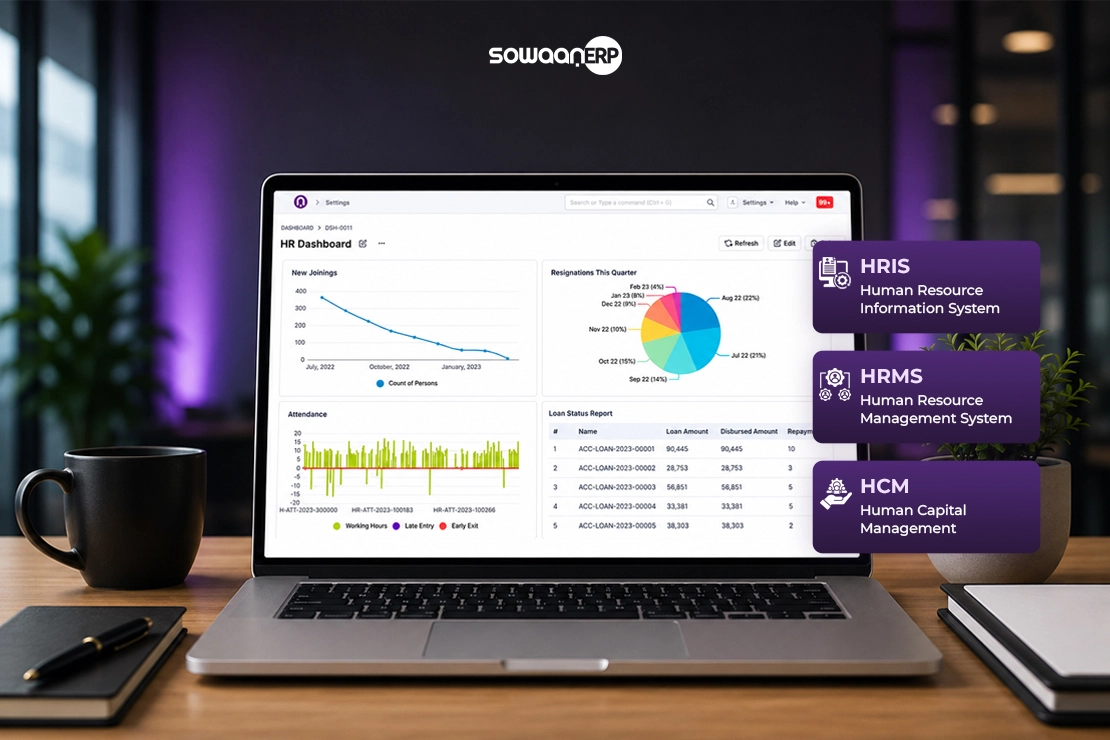
The HR management software market is expected to more than double, from $19.57 billion in 2026 to $31.89 billion in 2031 at a forecast CAGR of 10.29% between these years (Mordor Intelligence, 2026). With the advent of digitisation in regions, the decision on which enterprise software platform to go for is no longer a management decision alone.
Core HR & Master Data (HRIS) → Operational Automation (HRMS) → Strategic Talent & Analytics (HCM)
One of the most important decisions an IT and HR leadership team will have to make is which types of hr software to choose. The wrong system architecture leads to costly data silos, compliance issues and integration hurdles.
Knowing the technical differences between Human Resources Information System (HRIS), Human Resources Management System (HRMS), Human Capital Management (HCM), and Human Resources (HR) module of an ERP ensures that your system is able to support your operations on the spot and will grow seamlessly with your needs.
HR software manages all the information of the workforce in one single digital place and automates administrative, operational and strategic HR processes.
What Is HR Software?
HR software is essentially an enterprise software application that digitizes, centralizes, and automates HR administrative tasks. It is designed to eliminate the need for time-consuming and prone-to-error spreadsheets, file cabinets, and disparate legacy applications and provide a single, unified digital environment. Gartner in 2026 revealed that operational process friction is still the main factor compelling enterprises to modernize their core workforce architecture.
| Administrative | Operational | Strategic |
| Employee Records | Payroll & WPS Batching | Talent Acquisition |
| Document Repository | Time, Shift & Biometrics | Performance Reviews |
| Compliance Tracking | Benefits & EOSB Accrual | Workforce Planning |
There are three main features enterprise HR software categories perform throughout the employee lifecycle:
- Administrative Master Data Management: Keeping a single source of truth for personal data, visas, passports, contracts and organizational structure, with audit tracking.
- Operational Execution: Automation of day-to-day operational tasks such as time recording, shift scheduling, leaves, and calculation of monthly wages.
- Optimizing human capital in the structured acquisition of talent, performance assessment, learning management, and predictive succession planning.
If your business is already using a different system for accounting, inventory or client management, an ERP-based HR engine is the ideal option as you won’t have to develop some custom API bridges that will be broken during system upgrades.
HRIS vs HRMS vs HCM: Core Architectural Differences
One cannot tell the difference between them and use them interchangeably, as HRIS, HRMS and HCM have different degrees of scope, schema design and operation.
| System Architecture | Focus |
| HCM | Strategic Management — Talent, Analytics, Succession, Onboarding |
| HRMS | Operational Automation — Payroll, Time, Attendance, Benefits |
| HRIS | Core Master Data — Demographics, Visas, Organizations, Self-Service |
Compare your operational needs with the right HRIS, HRMS, HCM, or ERP approach.Not sure which HR architecture fits your UAE business?
HRIS: Core Employee Data Architecture
The foundation data repository is called a Human Resources Information System (HRIS). It is mainly used for static demographic data, organizational structure mapping, basic conformance tracking and Employee Self Service (ESS) functionality. An HRIS handles:
- Employee master records (Emirates ID, passport, visa status, labour card).
- The hierarchy of organizational charts.
- Conventional leave tracking and monitoring.
- Employee Self-Service (ESS) for profile updates and simple requests.
HRMS: Operational HR Automation
A Human Resource Management System (HRMS) is an extension of the HRIS platform, adding intricate transactional workflows and complex calculations. It is optimized for daily administration execution, and is the most common architecture used in operational business environments. The key functional modules are:
- Automated payroll calculation engines native to the region which are compliant with regional laws.
- Time, attendance and shift rostering using biometric identification.
- Gratuity calculations for Automated End-of-Service Benefit (EOSB).
- Loan, expenses, leave approvals that are automated.
HCM: Strategic Workforce Management
Human Capital Management (HCM) includes the entire architectural all-encompassing view of HRIS and HRMS, and includes high level strategic and talent focused capabilities. In the context of HCM platforms, medium to big-sized businesses that prioritize optimizing their workforce, managing employee performance and maintaining global talent pipelines will find the most value.
The following core strategic extensions are incorporated:
- Automated Application Tracking Systems (ATS) and automated candidate onboarding.
- Goal management, ongoing performance evaluations and 360-degree feedback loops.
- Skill track tracking and certifications using Learning Management Systems (LMS).
- Strategic workforce planning, skill gap analysis, succession modeling.
Unify your workforce and business operations in one ERP.
Connect HR directly with finance, payroll, projects, and operations instead of managing disconnected systems.
Architectural Breakdown: HRIS vs HRMS vs HCM
| Feature / Functional Scope | HRIS (Information System) | HRMS (Management System) | HCM (Capital Management) |
| Primary Functional Focus | Master data storage & compliance record-keeping | Operational workflow automation & transactions | Strategic talent management & workforce optimization |
| Target Business Size | Early-stage SMEs (10–50 employees) | Growing mid-market enterprises (50–500 employees) | Large enterprises & multinationals (500+ employees) |
| Payroll Processing | Basic tracking / Third-party integration | Advanced native payroll engine & automated wage files | Multi-country native payroll & localized tax engines |
| Time & Attendance | Basic leave balance tracking | Biometric hardware integration & complex shift management | Advanced labor forecasting & dynamic shift scheduling |
| Talent & Recruitment | Basic resume storage | Standard job postings & onboarding checklists | Full ATS, AI candidate matching, & onboarding workflows |
| Performance & Learning | Manual review upload | Periodic performance review templates | Continuous 360-degree appraisal, OKRs, & integrated LMS |
| Data Analytics | Operational static list reporting | Transactional dashboards & payroll cost reports | Predictive talent analytics, flight-risk modeling, & workforce trends |
What Is an ERP HR Module?
An ERP HR module is an entirely integrated sub-system within an Enterprise Resource Planning system (like Sowaan ERP), that incorporates human resources functions into the same relational database schema as the engines of finance, general ledger, procurement, asset management and project accounting.
| ERP Module | Primary Function |
| HR Module | Employee and workforce management |
| Finance – General Ledger | Financial transactions and accounting |
| Procurement & Assets | Purchasing, suppliers, and asset management |
| Projects & Billing | Project tracking, costs, and billing |
Contrary to apps that use sync scripts or webhooks in the background to access HR data, an ERP HR module views employee data as cost centers that are part of the organization’s real-time financial processes.
Businesses already using ERP for finance and operations should prioritize an HR module that shares the same core data architecture.
Standalone HR Software vs. ERP-Integrated HR
| Architecture | Data Flow | Key Characteristic |
| Standalone Architecture | Standalone HR → REST API / CSV Batch Export → Third-Party ERP Finance | Sync delays and API errors can cause data inconsistencies |
| ERP-Integrated Architecture | Sowaan ERP Core Data Layer → HR, Payroll, General Ledger & Projects | All modules access the same unified, real-time database |
When deploying various hr software, attention is needed on data flow architecture. Standalone types of hr software applications lead to information isolation, and manual recon with hr, payroll and corporate bank accounts.
Connect attendance, payroll, banking, accounting, and employee self-service through one centralized HR environment.Explore connected HR and payroll automation.
Comparison: Standalone HR vs ERP-Integrated HR Engine
Standalone HR Software
- Pros: Highly specialized feature set tailored specifically for talent acquisition, niche employee engagement tools, and independent deployment flexibility.
- Cons: Fragile database syncs, isolated financial reporting, additional licensing costs for API connectors, and duplicate user administration.
ERP-Integrated HR Module (e.g., Sowaan ERP)
- Pros: Native relational database shared with Finance & Operations, automatic General Ledger posting upon payroll approval, real-time project labor costing, and single-vendor maintenance.
- Cons: May require broader organizational alignment across accounting and supply chain teams during initial system setup.
When payroll, employee data and accounting information rely on separate databases and integrate with each other, there can be gaps in synchronization when you use a standalone HR system.
How HR, Payroll, and Attendance Data Flow Through an ERP
With an integrated enterprise system, data flows automatically from one validation step to the next, without human involvement.
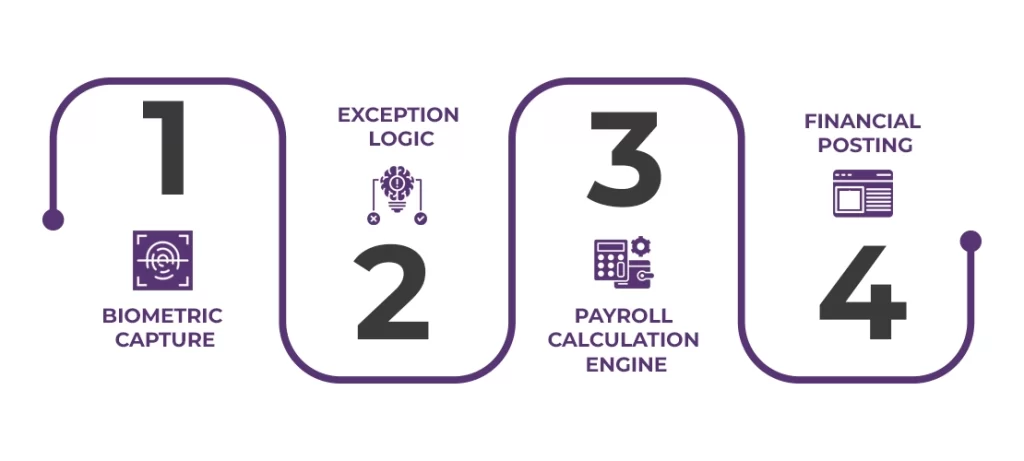
Step | Process | Key Functions |
1. Biometric Capture | Hardware registers check-in/out | Records employee attendance data |
2. Exception Logic | Absence, overtime, and leave calculated | Identifies and processes attendance exceptions |
3. Payroll Calculation Engine | Gratuity, basic pay, and deductions calculated | Automates accurate payroll calculations |
4. Financial Posting | Automated SIF and GL journal entry | Posts payroll data to financial records |
HR Software Integrations: Accounting, Attendance, Banking, and ESS
Efficient, modern enterprise HR platforms need to integrate efficiently and effectively between key operational areas:
Central HR Platform
Connects and manages:
- ESS Portal — Mobile/Web self-service
- Biometrics — API Gateway and hardware integration
- Banking — WPS SIF and direct bank integration
- Finance — General Ledger integration
1. Accounting and General Ledger Integration
Direct posting means salary expense, social security or pension contribution, bonuses and accrued liabilities (e.g. leave not taken, pension reserve) would automatically be booked to their respective GL Account codes without any manual journal entries. Mordor Intelligence for 2026 published market studies, mid-sized companies are not only required but should be obligated to integrate real-time accounting to manage labor overheads for 2026.
2. Biometric and Attendance System Integration
With direct integration, using webhooks or database connectors, IoT biometric devices (fingerprint, facial recognition, RFID access control) are directly connected to the payroll engine. This eliminates attendance uploads that are done manually and the tampering of time cards.
3. Banking and WPS Middleware Integration
Approved payroll runs are automatically formatted into bank-friendly file formats like Central Bank-compliant .SIF files). The files can be uploaded directly to corporate banking platforms through secure SFTP or API channels.
4. Employee Self-Service (ESS) Mobile & Web Portals
Web and mobile ESS interfaces enable staff to enter personal data, apply for leave, view past payslips and request document attestations (like salary certificates). This significantly cuts down on the HR team’s administrative demands for the day.
When you connect HR with your CRM, Project Management and Inventory/Stock modules, you can track the true project margins, auto-commission according to verified sales stages and connect labor costs directly to active client projects.
UAE-Specific HR Software Requirements
The use of generic international HR software solutions will often end up failing in the Gulf region because the software does not comply with the regional frameworks. When assessing HR Payroll Software or the best hr software in uae, organisations need to ensure that the end solution supports the necessary regulatory compliance needs:
UAE Regulatory Compliance Suite
- WPS Payroll
- .SIF Format
- Automated Files
- MOHRE Contracts
- Decree-Law 33
- Labor Workflows
- EOSB Accrual
- Article 51 Formula
- Automated Rules
- NAFIS Emiratisation
- Tracking & Ratio Reports
- Statutory Submissions
Explore connected HR and payroll automation.
Connect attendance, payroll, banking, accounting, and employee self-service through one centralized HR environment.
1. Wages Protection System (WPS) Compliance
All the employee salaries of mainland companies (as well as aligned free zone jurisdictions) must be paid via the Central Bank approved processing channels in the electronic Wages Protection System, subject to the regulations monitored by the Central Bank of the UAE.
The system needs to automatically format and validate the .SIF (Salary Information File) layout, which includes:
- 14 digit Establishment ID from MOHRE and 14 digit Employee ID / Labour Card Number.
- Accurate breakdown of Basic Salary, Fixed Allowances, Variable Pay, and Deductions.
- Automated validation checks to identify salary delays, underpayments or unauthorized deductions before submission, avoiding serious MOHRE blockages or fines.
2. UAE Labour Law (Decree-Law No. 33 of 2021) Workflows
The legal regime set out in Federal Decree-Law No. 33 of 2021 requires fixed-term employment contracts, flexible working arrangements, statutory rates of overtime (125% for overtime and 150% for night working or scheduled rest days) and parental and bereavement leave allowances.
3. End-of-Service Benefits (EOSB / Gratuity) Engine
UAE Labour Law Article 51 requires an automated, policy-driven computational engine for calculating end-of-service gratuity:
- Service Duration Parsing: precise Temporal Computation of service, automatically deducting leave days that are not paid.
- Gratuity Tiering: 21 days basic salary per year for first 5 years of service, 30 days basic salary per year for every year thereafter.
- Capping Rules: Two years’ total salary cannot be the total payout of gratuity.
Service Period: 1–5 Years → 21 Days’ Basic Salary per Year
Service Period: More Than 5 Years → 30 Days’ Basic Salary per Year
Maximum Cap → 2 Years’ Total Gross Salary
4. Multi-Branch & Dual Free Zone / Mainland Support
In the UAE, businesses often have several companies in various mainland jurisdictions and specialized free zones (like DIFC, DMCC, JAFZA or ADGM), each with different visa requirements, employment contracts and bank routing protocols. The system shall provide separation of data between different entities within a single tenant.
Running without native WPS file validation can have serious consequences for operations. Failure to comply or failing to process the salary in time after 15 days may lead to automatic suspension of the work permit issued by MOHRE and heavy financial penalties and blocking of commercial licenses.
Cloud HR Software vs. On-Premise HR Software
The decision between Cloud (SaaS) and On-Premise deployment not only affects capital expenditure and operational maintenance overhead but also data security governance. Cloud deployments will continue to grow at a compound annual growth rate of 11.55% worldwide through 2026, according to industry data from Stellar Market Research for 2026, which is significantly higher than the 7.76% compound annual growth rate of legacy on-premise solutions.
Dimension | Cloud HR Software (SaaS) | On-Premise HR Software |
Capital Infrastructure | Zero hardware investment; predictable monthly/annual OPEX | High initial CAPEX for local servers, storage, and networking |
Updates & Upgrades | Automatic updates ensuring continuous compliance with statutory UAE laws | Manual upgrade projects requiring internal IT labor and downtime |
Remote Access & ESS | Native, highly secure mobile app and web browser access anywhere | Requires complex VPN infrastructure or custom proxy configurations |
Data Residency | Hosted in secure regional data centers (e.g., UAE AWS/Azure regions) | Stored entirely on internal company servers inside the facility |
Disaster Recovery | Automated geo-redundant backups managed by the cloud provider | Manual backup procedures and dedicated off-site storage infrastructure required |
HR Software Security and Access Control
HRM software handles extremely confidential employee data and corporate financial information. Strong enterprise platforms adhere to strict security architecture standards that are regulated by national laws and regulations, such as the UAE Official Government Portal on Personal Data Protection:
- Granular permission configurations so that managers are only able to see direct reports operational data, and sensitive financial salary data is only visible to authorized payroll administrators.
- AES-256 bit encryption is required for data at rest through database tables and TLS 1.3 encryption is required for data in transit through web connections.
- Immutable audit logs of all salaries changes, document downloads, changes to user privileges, and changes to every record with userID and time metadata.
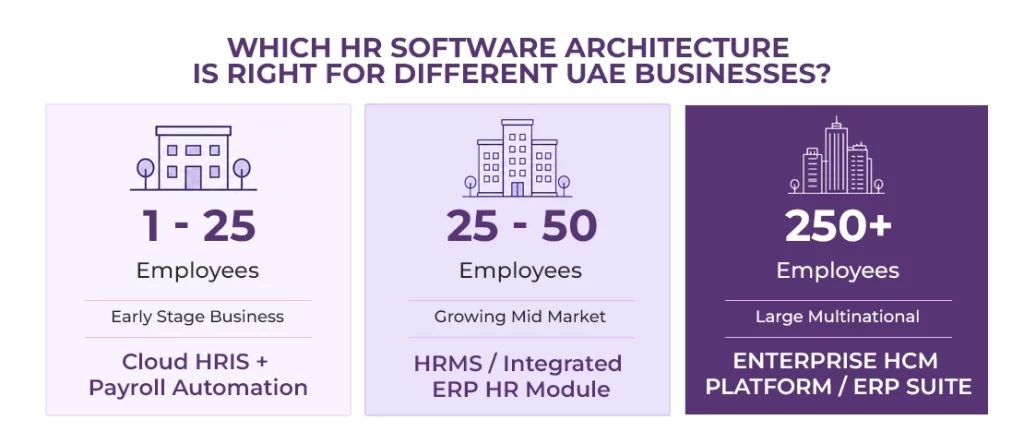
Which HR Software Architecture Is Right for Different UAE Businesses?
There are various options for hr software and it is important to choose the right one based on the business size, complexity, growth goals, and operational footprint:
Early-Stage Businesses (1 to 25 Employees)
- Recommended Choice: Cloud HRIS or Basic hr and payroll software.
- Rationale: Focuses on establishing centralized employee records, managing basic leave balances, and automating standard WPS file creation without overwhelming small teams with complex strategic modules.
Growing Mid-Market Enterprises (25 to 250 Employees)
- Recommended Choice: Complete HRMS or integrated ERP HR Module like Sowaan ERP.
- Rationale: Mid-market organizations require robust automated time tracking, biometric integrations, complex shift management, automated gratuity accounting, and direct general ledger synchronization to prevent operational friction.
Large Multinationals & Enterprise Groups (250+ Employees)
- Recommended Choice: Comprehensive Strategic HCM platform or Enterprise ERP Suite.
- Rationale: Enterprise organizations require multi-entity rollups, advanced talent acquisition systems (ATS), succession planning models, multi-country compliance frameworks, and deep business intelligence analytics.
Matching HR architecture to workforce size and operational complexity helps businesses avoid both underpowered systems and unnecessary enterprise complexity.
HR Software Selection Checklist for UAE Businesses
Use this strategic evaluation checklist when auditing prospective vendors to select the best hr software in uae:
Core Regulatory & Local Compliance
- Central Bank-compliant WPS .SIF file generation
- The UAE Labour Law (Decree-Law 33) formulas for gratuity are as follows:
- A system for monitoring the presence of MOHRE NAFIS staff in Emirati.
- Visa and Emirates ID and Passport expiries alert
Integration Capabilities
- Integrating a biometric time-clock API.
- Real-time integration with General Ledger and accounting system.
- The integration of local corporate banking system.
System Security & Data Governance
- Data masking and Role Based Access Control (RBAC)
- It is encrypted with AES-256 and TLS 1.3.
- Complete audit trails for compensation changes
- UAE region-based cloud hosting choices.
Scalability & User Experience
- Mobile-friendly Employee Self-Service (ESS)
- Multi-entity and free zone/mainland support
- Multi-currency payroll processing
Do not evaluate HR software only by its feature count. Prioritize UAE compliance, integration capability, security, scalability, and data architecture.
Unifying HR with Full Business Operations: Sowaan ERP
Though different types of hr software applications can stand alone to correct immediate personnel tracking needs, high growth UAE companies soon outgrow the siloed architectures. By integrating HR, payroll, accounting, inventory, CRM, and project management into a single, modular system, Sowaan ERP overcomes the operational disconnect between HR/payroll and core enterprise business units.
Comprehensive Business Capabilities Beyond HR
- Accounts & Finance
- Inventory & Multi-Warehouse Management
- Project Management & Job Costing
- Procurement & Asset Management
- CRM & Point of Sale (POS)
When companies implement Sowaan ERP, they get one, single scalable digital backbone, making their workforce more efficient and compliant with MOHRE and Central Bank regulations in all departments.
Bring your entire business onto one integrated ERP platform.
Go beyond HR and connect payroll, accounting, inventory, CRM, projects, procurement, and operations on one business platform.
FAQs
HRIS manages employee data, HRMS adds payroll and operational workflows, HCM adds strategic talent management, while an ERP HR module connects HR with finance and business operations.
Standalone HR software requires APIs or file exports to connect with finance. ERP-integrated HR shares a unified database, enabling real-time payroll and financial synchronization.
An integrated HRMS or ERP HR module is ideal for growing UAE SMEs because it automates payroll, WPS, attendance, and leave while reducing integration costs.
Yes. It can manage employee records, attendance, leave, payroll, WPS files, and accounting entries from one integrated platform.
Standalone systems use APIs or middleware, while ERP systems directly synchronize payroll data with General Ledger accounts when payroll is approved.
Compliant software generates Central Bank .SIF files, tracks submission requirements, and supports UAE Labour Law rules for payroll, leave, and gratuity.