Skip to main content
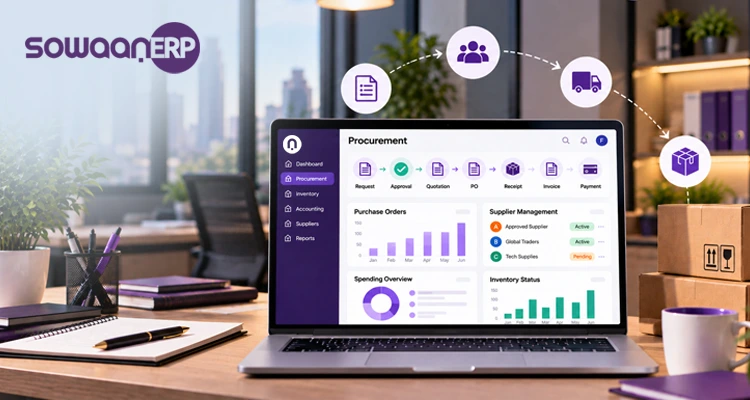
Almost all teams within a company have interaction with procurement at some level. Everything from initial identification of the need and screening of vendors to placing orders, receiving shipments, approving the invoice, and paying the bill requires careful control and meticulous documentation.
At this point, procurement management software proves its worth. Businesses can better control vendors, requests, quotes, POs, stock, billing, sign-offs, and related financials once a modern procurement system organizes purchasing into a digital pipeline.
Companies aiming to bridge procurement and broader company operations can lean on an integrated ERP, which connects purchasing directly into accounting, stock, sales, HR, project work, and other areas. Take SowaanERP: it comes with connected modules across finance, inventory, procurement, CRM, HR, sales, and project tracking.
Chart every step of your present purchasing path, beginning at requisition and ending at payment, before you select procurement software. That clarity helps you see where automation will do the most good.
What Is Procurement Management Software?
At its foundation, procurement management software is a digital tool that runs and automates how an organization handles its purchasing.
Companies can bring all procurement tasks into one central system, moving away from isolated spreadsheets, emails, paper documents, and accounting files.
Capability depends on the exact tool, but procurement software can assist with:
- Purchase requisitions
- Supplier quotations
- Supplier management
- Request for quotation (RFQ) steps and approvals
- Supplier comparison
- Purchase orders
- Purchase receipts
- Purchase invoices
- Approval workflows
- Inventory updates
- Payment processes
- Procurement reporting
- Purchasing analytics
- Overseeing budgets and costs
Digitizing paper files is not the main intent. More broadly, the point is to connect procurement end to end so that purchasing data circulates between procurement, inventory, finance, and leadership.
View procurement across the entire business instead of leaving it boxed in as a standalone buying desk. The choices made in procurement reach into inventory levels, cash flow, vendor partnerships, project budgets, and ledger reporting.
What Makes Procurement Management Software Work?
In a standard procurement setup, things get underway as soon as a department spots a requirement.
In the UAE, for instance, a trading outfit might find that storage shelves hold less of a specific good than they should. Then comes the purchase request, which users can generate, examine, and submit across the formal approval sequence.
Following approval, procurement can seek quotes from vendors, compare their proposals, pick a supplier, and issue a purchase order.
Arrival of the goods allows receiving details to be logged. Then the corresponding purchase invoice can be checked against the purchasing transaction and forwarded to accounting.
A simplified workflow looks like this:
From a Purchase Request and Approval, the chain runs through Supplier Quotation and Supplier Selection, moving to a Purchase Order, Goods Receipt, Purchase Invoice, and finally Payment.
Procurement process management software matters because it links all these stages together instead of treating them as separate steps.
Take the UAE platform from SowaanERP: it sits procurement and buying right beside accounts, finance, and stock management, so purchasing data operates within a wider ERP system.
Key Features of Procurement Management Software
Rather than just producing purchase orders, the right procurement management software should back the purchasing cycle in its entirety.
Purchase Requisitions and Approvals
Staff members or full departments have the option to ask for the goods or services they require. From there, the requests can travel through established approval workflows ahead of any purchasing.
As a result, businesses can enforce stricter checks on who is allowed to requisition, authorise, and buy items.
Supplier Management
Holding supplier details in a central system streamlines the handling of supplier records, past purchases, quotes, rates, and connected transactions.
Organisations that rely on dozens of suppliers can use unified supplier data to keep procurement teams orderly and evaluate partners more effectively.
Request for Quotation Management
Settling on a purchase often means procurement teams have to stack several supplier quotes against each other first.
With procurement software handling the layout of RFQs and vendor replies, buyers can work through their choices more methodically.
Organizations have applied SowaanERP’s procurement features to handling RFQs, matching supplier quotes, raising purchase orders, and following materials tied to specific projects.
Purchase Order Management
With the supplier settled on, the purchase order steps in as an essential mechanism for control.
Using procurement software, a business can issue, follow, and administer purchase orders alongside live links to suppliers, stock, and accounting balances.
Inventory Integration
Procurement and inventory cannot be treated as independent functions.
Better visibility into stock levels, incoming goods, warehouses, and material requirements helps businesses make purchasing decisions, provided purchasing and inventory are connected.
Any company running several warehouses or holding heavy stock counts on this especially.
Explore inventory management software to see how inventory management can work alongside procurement.
Accounting Integration
Procurement transactions eventually affect financial records.
A connected procurement system can help finance teams track purchase invoices, supplier liabilities, payments, expenses, and related accounting entries without repeatedly transferring information between systems.
SowaanERP’s accounting module supports purchase invoices, payment entries, purchase orders, bank reconciliation, accounting reports, and other financial processes.
For businesses evaluating accounting software UAE or accounting software Dubai, integration with procurement should be an important consideration.
Procurement Reporting and Analytics
Management needs more than a list of purchase orders.
Procurement analytics can help businesses examine:
- Purchasing expenditure
- Supplier performance
- Purchase volumes
- Purchase cycle times
- Outstanding orders
- Frequently purchased items
- Price changes
- Departmental purchasing
- Procurement trends
These insights can help procurement and finance teams identify patterns and make more informed purchasing decisions.
Procurement Management Software vs Manual Procurement
Many smaller businesses start with spreadsheets and email-based procurement because these methods are inexpensive and familiar.

However, manual processes can become difficult to manage as transaction volumes increase.
| Manual Procurement | Procurement Management Software |
| Spreadsheet-based records | Centralized purchasing data |
| Email-based approvals | Structured approval workflows |
| Manual supplier comparison | Organized quotation comparison |
| Separate purchase and inventory records | Connected procurement and inventory |
| Repeated data entry | Automated information flow |
| Limited visibility | Real-time operational visibility |
| Difficult reporting | Automated reports and analytics |
| Greater dependency on individuals | Standardized processes |
Still, going after the most sophisticated procurement tool out there is hardly necessary for every firm. Variables like company headcount, spend volume, day-to-day operational friction, vendor count, physical locations, storage facilities, and system integrations will dictate what fits.
It might be time to look into an integrated procurement system if your staff spends half their time shifting details back and forth among spreadsheets, inboxes, POs, inventory sheets, and the general ledger.
Why Modern Procurement Software Has Become Essential for UAE Enterprises
Across the UAE, commercial operations cut across varied fields such as trading, manufacturing, construction, retail, distribution, healthcare, professional services, and logistics.
No two sectors share the exact same procurement setup.
For a construction company, buying materials per contract and following vendor performance might be the central concern. Industrial manufacturers might need raw component sourcing that feeds directly into shop-floor output and stock figures. In distribution, keeping real-time tabs on inventory across multiple storage sites while ordering centrally may be what matters.
Manual inventory and purchasing workflows were central issues in SowaanERP’s UAE case study for Skyline Contracting, which explains how the ERP rollout addressed them using RFQs, supplier comparisons, purchase orders, stock transfers, and project material tracking.
The MFZ EURO case study covers a comparable scenario, tracking how a Dubai-based enterprise united its procurement, inventory, sales, finance, and project operations under one integrated ERP environment.
Why You Need to Integrate Procurement and Inventory Software
Inventory is immediately influenced by purchasing decisions.
A purchasing team that cannot track available stock, incoming items, or warehouse requirements risks ordering either too much or not enough.
Managing procurement and inventory through integrated software helps tie the two sides together.
For example:
Low Stock → Requisition → Vendor Selection → Purchase Order → Receiving → Stock Update
Work moves through a much more joined-up chain this way.
On its UAE platform, SowaanERP explicitly integrates purchasing and stock within the ERP, directing the inventory module toward balanced stock levels and the procurement module toward vendor oversight and orders.
It pays for procurement and inventory to collaborate on setting reorder triggers, who gets preferred vendor status, buying priorities, and sign-off caps.
Procurement Software and Accounting: Bringing Purchasing and Finance Together
Procurement and finance do not operate in silos; they are tightly linked.
From cash flow and supplier liabilities to inventory valuation, expenses, and final financial reports, a single buy can touch all of them.
That link makes it a mistake for any business to evaluate purchasing software without looking at its accounting requirements.
Running an integrated ERP setup reduces the chore of retyping purchasing numbers into accounting files.
Purchase invoices, payment entries, financial reports, and bank reconciliation tools all sit together inside SowaanERP’s accounting suite.
In the UAE, businesses must factor relevant tax obligations and accounting rules into whatever software they choose. The UAE Federal Tax Authority observes that tax accounting software helps taxable persons significantly when they need to log and submit accounting records for tax returns.
Merely tracking what a company buys does not warrant calling procurement software “tax compliant” by default. Organizations ought to examine a platform’s precise features for accounting, tax, and e-invoicing to see if they satisfy what is required of them.
UAE E-Invoicing in the Context of Procurement Management Software
Work is also advancing in the UAE to establish an electronic invoicing framework.
The Federal Tax Authority puts out the official documentation on the UAE e-invoicing setup, encompassing criteria for accredited service providers alongside Ministerial Decision No. 243 of 2025.
This shift raises the stakes for companies vetting procurement management software, who must ensure purchasing hooks cleanly into accounting, billing, and wider ERP operations.
That said, procurement platforms are not identical to e-invoicing systems.
Purchasing workflows run through procurement software, but e-invoicing is about transmitting and reporting billing data to comply with the relevant UAE framework.
During procurement management software evaluations, UAE businesses need to question vendors on precisely how buying data links to accounting, regular billing, and future e-invoicing rules.
Traditional Systems VS Cloud Procurement Software
Staff with the right permissions do not need to sit at a dedicated on-site computer; cloud procurement setups let them pull up records from any linked device.
This setup proves especially practical when a firm operates multiple branches, warehouses, or regional sites, or employs staff who track orders away from base.
In its own product descriptions, SowaanERP emphasizes a modular, cloud-hosted architecture that scales easily and connects internal business operations together.
Just being newer technology is no reason to adopt a cloud setup on its own.
Businesses should evaluate:
- Data security
- Access controls for users
- Backup processes
- Integration capabilities
- Scalability
- Vendor support
- Customization requirements
- Implementation methodology
- Complete cost of ownership
How to Settle on the Right Procurement Management Software
Not one procurement system on the market is an automatic fit for every company operating in the UAE.
What businesses should do instead is weigh prospective software against what they specifically need to buy.
Consider the following checklist:

- Procurement workflow: Is the tool capable of running your purchasing cycle from end to end?
- Supplier management: Will you be able to log vendor details and weigh competing bids?
- Approval controls: Will the software let you match purchasing sign-offs to how your company is organized?
- Inventory integration: Will the purchasing module speak directly to your warehouse data and stock registers?
- Accounting integration: Will buying data carry over automatically into your accounting software?
- Reporting: Does the platform generate procurement figures and summaries that are genuinely helpful?
- Scalability: Can it comfortably take on more locations, depots, logins, and order volume?
- Integration: Can you link it to the other software systems currently running across your company?
- Implementation: Does the vendor assist with system rollout and user instruction?
- UAE requirements: Is the vendor capable of showing how their system accommodates relevant UAE tax, accounting, and e-invoicing processes?
Request a walkthrough of your actual procurement workflow from vendors instead of settling for only a canned product pitch. Provide an end-to-end example, such as: “create a purchase request, obtain three quotations, approve the supplier, create a PO, receive the goods, and process the invoice.”
How ERP Software Elevates Procurement Management
While standalone procurement tools certainly serve a purpose, procurement gains far greater impact when tied to an ERP system.
An integrated ERP can connect:
Procurement, together with Inventory, Accounting, Sales, CRM, Projects, HR, and Reporting
As a result, management gains a wider perspective on day-to-day operations.
For instance, making a purchase can alter inventory counts. Sales availability, in turn, can depend on inventory. What gets billed on a purchase invoice can feed into accounts payable. Project costs can change based on purchasing done for the project.
An ERP system bridges these moving parts rather than keeping them walled off from one another.
Explore ERP modules to see how different business functions can work within an integrated ERP environment.
Why Consider SowaanERP for Procurement Management?
SowaanERP provides a modular ERP platform for businesses that want to connect procurement with other core business functions.
Its UAE platform includes procurement and buying alongside accounts and finance, stock, CRM and sales, HR and payroll, and other ERP capabilities.
Businesses can also explore specialized capabilities through:
- Accounting software
- Manufacturing ERP
- Distribution ERP
- Asset management module
The vendor’s work with UAE clients also shows procurement tied directly into inventory, finance, sales, manufacturing, and project workflows.
Implementing Procurement Software: What Businesses Need to Have Ready
Getting the software installed is only part of what makes an implementation work.
Before rolling anything out, companies need to map out how they currently buy things and pin down:
- Who is authorized to raise purchase requests
- Who signs off on purchases
- Which suppliers the business actively uses right now
- The specific products and services being bought
- Which departments are doing the buying
- The way vendor quotes get reviewed
- The way purchase orders get generated and sent
- The intake process for incoming shipments
- The process for reviewing supplier invoices
- The sign-off process for vendor payments
- The specific procurement reports leadership requires
Before migrating, companies also need to scrub their vendor and product records into a consistent format.
Never layer automation over a messy process without auditing it beforehand. Automated systems deliver the most value when the data model, approval thresholds, roles, and core process steps are already spelled out.
Ways Procurement Software Helps Track and Lift KPIs
Centralizing purchasing data allows businesses to track procurement KPIs with far more consistency.
Useful metrics may include:
- Time required to complete a purchase order
- On-time and accurate supplier deliveries
- Variances in purchase price
- Total count of approved suppliers
- Procurement savings
- Error rates in purchase orders
- Approval time
- Emergency purchases
- Stock-out frequency
- Breakdown of procurement spend across departments
- Breakdown of procurement spend by vendor
Procurement managers can use these figures to spot where things are backing up and what needs fixing.
Common Procurement Management Challenges
Software alone is not enough; companies still have to establish clear procedures and rely on accountable staff.
Common challenges include:
Poor data quality: Bad records for suppliers or items can distort buying choices.
Unclear approval structures: Workflows drag out when staff are not sure who holds signing authority for purchases.
Lack of supplier evaluation: Companies often stay with vendors simply because they never audit their track record.
Disconnected inventory: Buying goods without knowing exact stock levels leads straight to stockouts or bloated warehouses.
Weak integration: When procurement and finance run in separate silos, staff often end up typing the same records in twice.
Poor user adoption: No matter how capable the software is on paper, it falls flat if staff fail to run it properly.
Industry-Specific Procurement Software Across the UAE
Manufacturing
Raw material buying can be tied directly to stock levels and factory floor demands. To keep purchasing and production moving, SowaanERP builds inventory control and direct vendor links into its manufacturing tools.
Construction
Builders often have to handle job-specific purchasing, monitor suppliers, process material requests, and keep track of items out on site. How these purchasing and job controls run inside a single ERP setup is clear from the Skyline Contracting example.
Trading and Distribution
By tying purchasing to inventory, traders can handle vendor orders, monitor available stock, run their warehouses, and track the books in one flow.
Healthcare
For medical goods, clinic hardware, and day-to-day consumables, healthcare providers often need more formal purchasing processes and vendor oversight.
Retail
Retail businesses can feed sales figures and inventory data straight into purchasing so shelves stay stocked and reorders go out on time.
Summary: Setting Up a Connected Procurement Workflow
Buying is no longer just a matter of raising POs.
In an expanding UAE company, buying ties straight into vendors, stock levels, bookkeeping, cash positions, project timelines, and broader operations. Dedicated procurement software pulls these pieces into an organized digital setup, cutting back on repetitive manual tasks and showing where things stand.
You will get the best results by judging software against the entire purchasing cycle instead of ticking off standalone features.
An integrated ERP system offers a wider digital base for teams wanting purchasing tied directly to finance, stockrooms, sales orders, projects, and daily operations.
Take a look at SowaanERP and its modular tools if your UAE business needs procurement software embedded in a wider ERP setup.
Ready to streamline purchasing, supplier management, inventory, and finance?
Explore SowaanERP UAE and to discuss your procurement requirements.
FAQs: Procurement Management Software in the UAE
Procurement management software gives companies a digital hub to run purchasing tasks, covering vendor records, quote reviews, requisitions, POs, receipt tracking, invoices, sign-offs, and spend reports.
This software centers on structuring and automating every purchasing step, starting when a need is identified and running through vendor selection, PO generation, delivery receipt, invoicing, and final settlement.
Yes. It can run directly as an ERP module or hook into a separate ERP setup. Connecting the systems lets purchasing share data directly with inventory, accounting, sales, project tracking, and other departments.
Yes, though it varies from one platform to another. Connecting them allows purchase records, vendor bills, outgoing payments, and general financial files to flow together. Companies need to check directly with the vendor to see what tax and accounting features are actually supported.
Purchasing workflows and supplier interactions are the primary focus of procurement software. An ERP system offers a wider operational footprint, tying procurement directly into accounting, inventory, sales, HR, project tracking, manufacturing, and other departments.
Yes, especially if the company deals with rising supplier numbers, routine purchasing, tiered approvals, stock tracking, or blind spots in overall spending.
Companies need to check purchasing workflows, vendor tools, approval chains, stock and accounting ties, reporting, security, growth capacity, setup support, and local UAE compliance rules.
The software cuts hands-on work by automating or standardizing requisitions, approvals, RFQs, vendor comparisons, purchase orders, goods receipts, reports, and cross-department data handoffs.
Yes. Within its wider ERP setup, SowaanERP’s UAE platform features a Procurement & Buying module built to handle purchasing, vendor management, and cost tracking.