
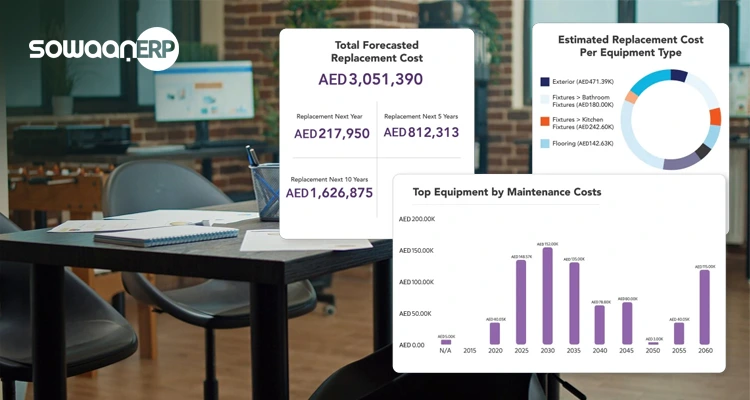
Plants, machinery, vehicles, buildings and other business assets are becoming more and more difficult to manage under a growing organization. Spreadsheets and individual data sets can function for a small operation. However, they may make it difficult to supervise maintenance, supervise asset conditions, inspect costs and provide replacement services in different locations.
Enterprise asset management software helps businesses manage assets and life cycle are from buying and installing until maintenance, depreciation and disposal. UAE companies active in the construction, manufacturing, logistics, real estate and facility management can have a centralised asset management system boost visibility and help inform operating decisions.
The appropriate solution is more than the holdings of just an entity of assets. The report defines the relationship between asset records and maintenance plans, spare parts, procurement, and financial reporting that help teams understand how assets work and how the value of property is.
What Is Enterprise Asset Management Software?
Enterprise asset management (EAM) is a digital system for controlling all physical life cycle of an organization. It centralises asset records, maintenance activities, purchase orders, expenses, guarantees, inspections, and performance information.
Instead of storing individual spreadsheets for equipment, service requests and repair costs, businesses can manage information within one system.
The construction company will be able to track excavators, cranes, generators, and other machines in different locations within the project with the Dubai EAM software. Maintenance teams may assess service history, plan inspections, record errors and monitor availability of each machine.
However, the manufacturer may use the system for planning maintenance’s prevention, the monitoring of equipment parts and the identification of equipment, which is often the result of production delays.
The asset management module that links assets to maintenance, inventory and funding processes may be a complete solution. Before Selection of Software, the list of assets that you must manage, the matters you want to handle, and the information required by any department. This will help you to make a distinction between key qualities and unnecessary complexity.
How Does Enterprise Asset Management Software Work?
EAM provides substantial data for each asset. In a system-specific list, an asset identification number, location, date of acquisition, details of guarantees, history of the service, designated unit, maintenance requirements and related costs may be included.
In such a case, the system will support the activities that are required for management of such assets over their useful life.
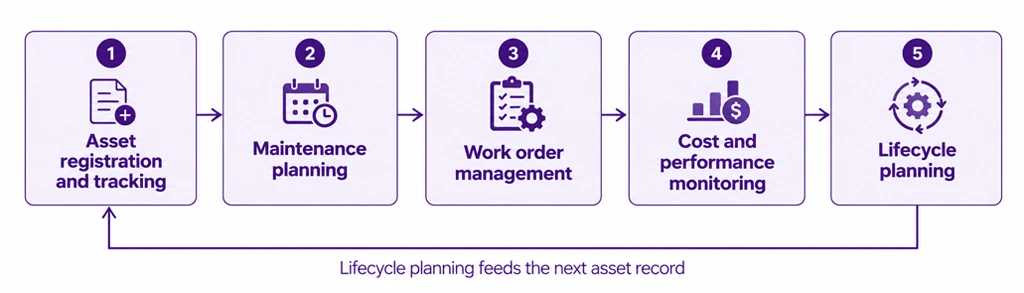
1. Asset Registration and Tracking:
Companies will use a central database to gather their assets and assign their identities, including barcodes, QR codes and RFID tags, in support of them. Teams can use the identifier to check the equipment’s location, verify the owner of the device and update its data sets.
2. Maintenance Planning:
Maintenance teams generate preventative maintenance schedules based on time, operating hours, usage or other supported triggers. The system may generate work orders and, where appropriate, notify the relevant staff.
3. Work Order Management:
Personnel responsible for monitoring or repairing equipment may record the problem and allocate work to technical staff. The order of activities shall consist of tasks, labour, constituents, status and features of completion.
4. Cost and Performance Monitoring:
The management assesses maintenance fees, assets, repair costs etc. If a machine fails several times, its maintenance history can help determine whether it can attend to maintenance, renovation or replacement.
5. Lifecycle Planning:
Asset Records supports decisions regarding the purchase, transfer, maintenance and disposal of equipment. The team could also help align assets with records, with financial systems which are linked to EAM.
Key Features to Look for in Enterprise Asset Management Software:
The best software available for Enterprise Asset Management is according to property’s type, operating conditions, service demand and today’s available technology. Many valuable skills, however, exist.
Centralised Asset Register:
The Central Asset Register shall provide consistent data on the asset position of equipment, buildings, vehicles, machines and other assets. Search for configurable fields, asset categorisation, Track location, document storage and secure history of transition.
Preventive and Predictive Maintenance:
Inspection and preventive maintenance before possible problems occur. Predictive maintenance uses status data, sensor measurements or analytical models to detect possible signs of possible malfunction.
These approaches are not interchangeable. Generally, Predictive maintenance requires appropriate device data, sensors, integration and analytical functions. Confirm what the software supports instead of accepting predictive functionality.
Work Orders and Technician Scheduling:
Work Order tools help managers repair it, give priority to urgent jobs, register the labor force and control the work’s completion. Mobile access can facilitate the update of various websites by businesses working on the field.
Spare Parts and Inventory Control:
Maintenance depends on having the right replacement parts available. EAM software connected to spare parts and inventory management can help teams monitor stock levels, record parts used in repairs, and identify items that need replenishment.
Asset Cost and Financial Reporting:
The reporting of assets should help managers understand the cost of purchases, maintenance, absence of office hours, and the need for substitution. Integration with accounting software can reduce duplication of data entry, and enhance transparency in operational and financial data.
Dashboards and Performance Reports:
Convenient dashboards show more than total assets. They may show delays, re-failure, maintenance costs of equipment utilisation and work order backlogs depending on the data. Choose Reporting Features based on your team’s choices. A maintenance manager may need running orders and failure trends behind the clock, while a financial manager could focus on asset values, spending and replacement projections.
What Are the Different Types of Enterprise Asset Management Solutions?
Not all of these entities need a separate EAM platform. While others will benefit from asset management being connected to larger operating systems, some businesses need special maintenance.
1. Standalone EAM Software:
EAM software’s choice is to be targeted for maintenance planning of asset lifecycle management, work orders, inspection and monitoring of the results. It is suitable for organisations with complex maintenance needs or lots of material assets.
The company’s suitability for a transaction depends on whether it may share information with existing financial, purchasing and inventory systems.
2. Computerised Maintenance Management System (CMMS):
A computerised maintenance management system (CMMS) is primarily focused on maintenance, and the general functions comprise prevention, work orders, maintenance history and inventory.
If the main objective is to arrange maintenance, the choice of CMMS may be practical. EAM usually uses a wider lifecycle approach, which combines maintenance and asset planning, spending, and long-term solutions.
3. ERP-Integrated Asset Management:
A ERP system connects a number of business functions such as finance, procurement, inventory and operations. Elements of asset management may assist enterprises to coordinate financial acquisitions, maintenance, stock utilization and financial reporting.
The enterprise asset management ERP Software can reduce the information gap between divisions for growing organisations. Servicing planning’s level, job requests and product controls and module, however, varies from product to product.
4. Cloud Enterprise Asset Management Software:
The Cloud enterprise asset management software is installed in a cloud infrastructure and can be accessed through Internet for connected devices. It may give information on the assets in factories and project sites to authorized groups, from sites to warehouses.
The mechanisms for access control, backup and restoration mechanisms, data processing environment, integration options. Responsibility for security are assessed before selecting a cloud platform.
The UAE’s personal data protection framework is relevant when a system processes personal data. Businesses should assess the law’s applicability to their circumstances and verify the provider’s controls.
5. On-Premises EAM Software:
The On-premises software will be used on infrastructure which was maintained on behalf of the organization or service provider. This may apply to companies that require a certain infrastructure or require more direct control of their technical environment.
But the organization will have to plan for infrastructure, upgrade, backup, cyber security and maintenance.
EAM vs ERP vs CMMS: What Is the Difference?
Although EAM, ERP, and CMMS can overlap, they serve different primary purposes.
| System | Main purpose | Common use cases |
|---|---|---|
| EAM | Manage assets throughout their lifecycle | Asset registers, maintenance, lifecycle planning, performance analysis |
| CMMS | Organise maintenance work | Work orders, preventive maintenance, inspections, service history |
| ERP | Connect business-wide processes | Finance, procurement, inventory, accounting, operations, and available asset functions |
The company may use all three concepts, either by individual products or by means of an integrated platform. The correct configuration is based on the operational complexity and selected software functions.
For example, in a special plant maintenance requirements, a EAM solution relating to ERP could be required. A small company can see the ERP Assets Management tool available to it to meet its needs. Demonstration by the During supplier to request a supplier to demonstrate the entire asset record-keeping, graphical adherence, spare parts sharing of repair costs and monitoring of receipt of the report It demonstrates how well functions function.
Benefits of Enterprise Asset Management Software for UAE Businesses:
Reduced Unplanned Downtime:
The maintenance that is planned and maintenance’s documented history allows groups to recognize recurring problems and to systematically address maintenance requirements. Due to the follow-up of the staff’s maintenance plans, this avoidable interruptions may be reduced in spite of the fact that the actual results depend on the condition of the equipment, the quality of execution, and.
Better Asset Visibility Across Locations:
Enterprises operating on Dubai, Abu Dhabi, Sharjah and other entities operating on Emirates may be forced to control equipment to be distributed between office, facility, stores, and project locations. Central records help authorised teams review Assets locations, vacancies, and maintenance status.
More Controlled Maintenance Spending:
After work, spare parts, maintenance contracts and maintenance frequency are used by supervisors to get their idea of where maintenance costs will be incurred. This information can, over time, form the basis for decisions on repair, sale and exchange of equipment strategies.
Improved Accountability and Recordkeeping:
The common quality of asset registers and contract data facilitates the verification of maintenance activities, the identification of information’s lack and the determination of the responsibility for asset transfer and maintenance.
Better Coordination Between Departments:
The link between asset accounting and procurement, inventory and finance reduces duplication of data entry efforts. The Management also contributed to a better understanding of the operating and financial consequences of asset-related decisions.
Enterprise Asset Management for Construction, Manufacturing, and Facility Management:
Various sectors require different asset management workflows, and software should reflect the use of assets in the real world.
Construction and Equipment Rental:
Construction companies can manage excavators, cranes, generators, vehicles and other machines in several locations. EAM can help track operating intervals, inspection reports, the history of repair and equipment availability.
Observation, geo-financing and automatic telemetry of the GPS apparatus should be seen as specific verification capabilities. It can go hand in hand with a need for compatible devices, integration or individual services.
Manufacturing:
Manufacturers rely on manufacturing facilities, utilities, tools and support facilities. EAM could facilitate coordination between scheduled maintenance and production plans and track repeated failures of the equipment.
Where supported, integration with sensors or industrial systems can supply operational data to monitor the status and predict maintenance.
Real Estate and Facility Management:
Real estate operators are required to operate buildings systems like lifts, HVAC, pumps, generators, fire trucks, and other critical infrastructure.
Coordination of planned inspections, maintenance applications, contractual works, asset warranties and maintenance documentation for various facilities can be a priority for the facility management software valuation firms.
Companies searching for Facility Management Software UAE or Facility Management Software Dubai have to confirm whether the solution supports their particular facilities, contractor workflows and reporting requirements. Facility Management ERP can be useful, if you are required to accompany the maintenance of acquisition, inventory, and finance.
Logistics and Transportation:
Logistics companies can use EAM for vehicles, freight, storage and other business activities. The history of the planning and maintenance history can assist managers in planning and understanding equipment’s availability.
How to Choose the Best Enterprise Asset Management Software:
Choosing the correct solution will start with operational requirements and not only with a feature check list.
1. Identify Your Asset Management Needs:
Provide the teams with the assets to manage their installations, duties and duties. Identify major current issues such as missing services, unreliable records, recurring errors, or difficult repair cost verification.
2. Check Integration Requirements:
Determine if the ERP system should be linked with accounting, acquisition, inventory, GPS, IoT or existing maintenance tools. Ask suppliers to explain what integrations are native, what APIs will need and which additional costs will be generated.
3. Evaluate Reporting and Access:
Confirm that software is able to generate reports that are needed by managers to ensure proper access to people in different locations. If you need the Arabic interface or bilingual coverage, check these features for demonstration purposes.
4. Review Security and Data Handling:
Ask where the data is being hosted, how the access is managed, how the backup is being checked and how the provider responds to security incidents. Before a deployment model is chosen, the contractual obligations and applicable UAE requirements should be reviewed.
5. Compare Total Cost of Ownership:
Don’t compare the subscriptions to the software alone. This includes implementation, data migration, integration, training, support, hardware or sensor tools, personalization and future modernization.
6. Test the Software Before Committing:
Use demo or pilot project to test physical asset and process data sets. Including maintenance, plant managers, financial groups and IT in order to satisfy the practical requirements of the final decision.
How Much Does Enterprise Asset Management Software Cost?
UAE is not charging any price on software for managing enterprise assets. The costs depend on the asset numbers and user numbers, the necessary modules, implementation models, complexity of integration, adjustment and support systems.
Common cost components include:
Licensing or subscription:
Stationary fees or software license fees.
Implementation:
Business Processes and Project Management system configuration.
Data migration:
Cleaning and transport of asset records out of spreadsheets or old systems.
Integrations:
EAM linkages with ERP, sources of financial, inventory or technical data.
Devices and infrastructure:
If required, Barcode scanners, RFID readers, Sensors, GPS devices or servers.
Training and support:
Post-start system preparation and maintenance.
For purposes of substantive comparison, please provide a written quote based on the same levels of asset, modules, duty stations and service requirements. Ask suppliers to separate one-off charges from repetitive ones. Calculate the potential according to your own basic information. Check working time, maintenance and spare parts and management prior to implementation. Compare these numbers to actual results after the rollout, instead of relying on generic ROI promises.
How to Implement Enterprise Asset Management Software Successfully:
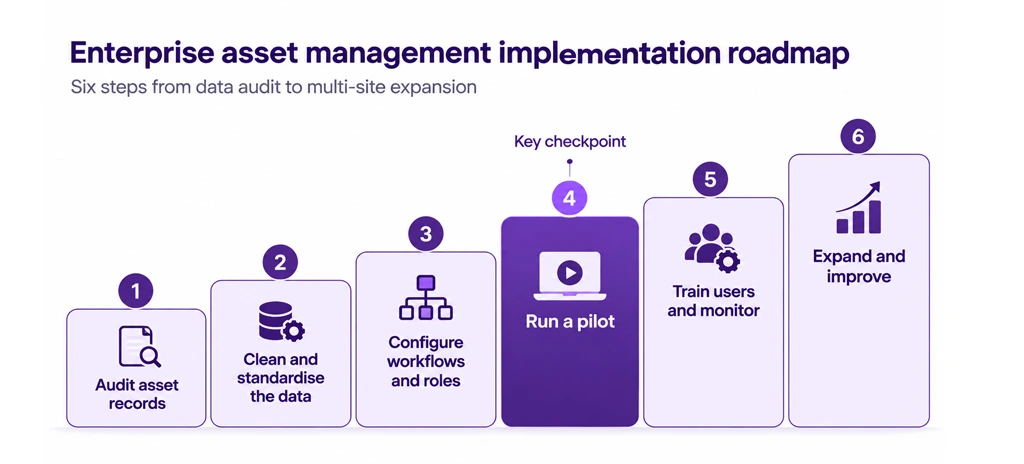
Step 1: Audit Existing Asset Records:
Gather spreadsheets, List devices, Service Registers, Warranty Documents and Related Financial Information, and the discovery of assets duplicates, missing identifiers, inconsistent locations and outmoded information.
Step 2: Clean and Standardise the Data:
Agreement on asset categories Convention Names, unique identification and location codes. Check important fields before migration to avoid transfer of errors to the new system.
Step 3: Configure Workflows and Responsibilities:
Define who can create asset records, authorise work jobs, register maintenance, tight transmission equipment, and complete orders. Identifying priorities in terms of maintenance and escalation.
Step 4: Run a Pilot:
Start with a managed set of assets, institutions or departments. Test Asset Registration, orders for work, spare parts of Use, reporting and integration for deployment.
Step 5: Train Users and Monitor Results:
Supplying role specific training and documentation procedures. Track acceptance, accuracy of the record, later maintenance and execution of an order during first implementation.
Step 6: Expand and Improve:
Extension of the system to new sites if the pilot fulfils the agreed acceptance criteria. Perform a regular review of performance of work and changing the business process when operational requirements are changed.
The implementation schedule varies in terms of data quality, integration, asset complexity and availability of domestic stakeholders. A focused rollout may be faster than a multi-site deployment with extensive customization, enabling you to create a project plan with clear milestones. Avoid miGrates any spreadsheet field without any review. Any unwanted, duplicated or unreliable data can be difficult to use from the very first day into a new asset management system.
How Can EAM Software Support Asset Recordkeeping and Financial Control in the UAE?
Asset management consists of both operational and financial information. A company may need to maintain a record of the procurement activities, asset registers, operating expenses, the history of transfers and disposals for accounting, taxation and internal auditing purposes.
The UAE Federal Tax Authority provides VAT guides and references to help businesses understand their tax obligations. Its guidance includes recordkeeping considerations, while the UAE government also explains that VAT-registered businesses must maintain commercial records that allow transactions to be checked.
EAM can support this process with organized asset and related transactions of financial systems. But software alone does not ensure compliance with tax regulations, correct accounting and all applicable accounting requirements are fulfilled. Companies should recognise their debt to qualified accountants and tax consultants.
How IoT and Predictive Maintenance Are Changing Asset Management:
IoT devices can collect information such as temperature, vibration, pressure, operating hours or the device’s condition. If compatible data sources are associated with the EAM software, teams can detect unusual events and prioritise inspections.
For instance, vibration measurements of production apparatus may show a potential mechanical problem. A networked system could draw attention to reading for investigation, and support service teams in making them operational.
The practical value depends on sensor quality, the connections, the accuracy of the data and the ability to interpret the readings. Not all assets require sensors, and not every EAM product provides predictive analytics as default functions.
Companies working on IoT should start with assets for which time at time off is costly and safety and reliability important.
Improve Asset Visibility and Control with Sowaan ERP:
Effective asset management needs more than the equipment list. Companies need reliable data, scheduled maintenance, clear accountability and useful reporting to help make more effective decisions about their assets.
For UAE organizations comparing Enterprise Asset Management software, priority must be a solution consistent with existing workflows and can combine asset information with relevant operational and financial processes.
Explore Sowaan ERP to learn more about its ERP capabilities and discuss how an integrated approach may fit your business requirements. To assess the right setup for your organisation, talk to our team about your asset management workflows, integration needs, and implementation priorities.
FAQs
It provides life cycle assistance to businesses to manage tangible assets, including asset registration, maintenance planning, business orders, service history, cost tracking and replacement planning.
It’s useful for organisations to manage a considerable amount of assets, especially in the areas of construction, manufacturing, logistics, utility companies, real estate and facility management. The appropriate solution will be determined by the complexity of assets and operational requirements.
Pricing depends on software, asset and user numbers, modules, integration, implementation models, the deployment requirement, and support efforts. Businesses need to look into Quotes based on real needs.
A CMMS mainly organises maintenance activities including the work orders and the preventive maintenance. In general, EAM includes a wider asset lifecycle which includes maintenance, asset planning, cost and performance indicators.
Yes, many solutions can be connected via integrated connectors, APIs or other integration technologies to the ERP platforms. Options are product dependent and must be checked with the supplier.
There are many EAM support preventive maintenance Systems and work orders systems. Confirm that your schedule may be based on data, time of use or other moments that your equipment can trigger.
Neither is universally better. Cloud solutions can facilitate access to the infrastructure across locations, and provide more direct infrastructure control for on-premises deployments. Compare the costs of IT, security, integration, support and potential.
It focuses on asset history and helps teams coordinate maintenance, cost, performance and design of repairs or replacements over an asset lifetime.
Construction, manufacturing, logistics, transport, real estate, utility companies and facility management are very common cases of use. This could be the benefit of any organisation with assets requiring tracking, service, or lifecycle planning.
Timelines depend on data quality, websites and assets, integration, customisation and user readiness. Before a broader roll-out, a pilot can define a realistic timetable.