
For small businesses in the UAE, the process of keeping track of their employees with spreadsheets, email, attendance sheets, and even with separate payroll software can become challenging at some point.
Initially, an HR team’s needs might include just an employee list and a monthly payroll file. However, HR must deal with attendance / leave, salary information, employee documents, recruitment, onboarding, payroll, reporting and compliance processes as staff numbers grow.
It isn’t always about the number of staff.
It’s the amount of HR processes that need to join forces.
Here’s where HR software for small business can come into handy.
A centralized HR system can integrate employee records, attendance, leave, payroll, reporting and employee self-service into one place, rather than having to maintain multiple files.
Payroll management for UAE companies should also consider local needs like the Wages Protection System (WPS). According to the UAE Ministry of Human Resources and Emiratisation, WPS is an electronic wage-transfer system that allows for the timely and precise payment of agreed wages.
For the latest information on UAE private-sector employment laws and regulations, visit the UAE Government’s official employment regulations guide
HR software is not a substitute for HR professionals. It streamlines repetitive administration tasks and provides HR teams with a more organized approach to managing employee data and processes.
Efficiently handle Your Small Business's HR management:
Manage employee records, attendance, leave, payroll, and HR processes all in one place, optimized for UAE businesses.
HR Software for Small Business: What is it?
Human Resource software for small business is a computer-based system that integrates and streamlines HR tasks including attendance, employee records, leave, payroll, recruitment, performance and reporting.
HR teams can work with one system, rather than multiple spreadsheets, to keep employee data organized.
A company with 20 employees will need:
- Employee records
- Attendance
- Leave management
- Payroll
- Payslips
- Basic reporting
As the number of employees in the company increases (more than 100), the following might be required:
- Recruitment
- Employee self-service
- Biometric attendance
- Automated payroll workflows
- Department-level reporting
- Performance management
- Multi-branch management
The integration of ERP and accounting:
The right solution must therefore be in line with the complexity of the company now, but also be flexible enough to accommodate growth.
So, why is HR software necessary for small business in UAE?
They typically have a small staff in small businesses.
A single HR employee can have multiple activities in progress at one time such as attendance, leave, payroll co-ordination, recruitment etc., and reporting.
Manual processes consume time that could otherwise be spent on workforce planning and employee engagement.
A centralized HR system can help businesses:
- Reduce repetitive administrative work
- Centralize employee records
- Automate attendance and leave workflows
- Improve payroll processing
- Generate reports faster
- Give employees self-service access
- Standardize HR processes
- Improve management visibility
- Support business growth
The UAE’s WPS framework makes accurate and timely wage processing particularly important for covered employers. MOHRE states that private-sector establishments participate in WPS through approved financial institutions and channels. HR software should support compliance workflows, but businesses should not assume that purchasing software automatically makes them compliant. Payroll rules, employee data, approvals, and system configurations still need to be maintained correctly.
Key Features of HR Software for Small Business UAE:
When evaluating hr software for small business uae, companies should focus on the features that directly solve their HR problems.
Employee Information Management:
A centralized employee profile can store information such as:
- Employee details
- Employment information
- Department
- Designation
- Joining date
- Salary information
- Documents
- Leave history
- Attendance records
This creates a single source of employee information instead of requiring HR teams to search across multiple files.
Attendance and Time Tracking:
Manual processes are a frequent source of issues with attendance.
Today’s HR solutions can help handle employee schedules, overtime, attendance and biometric device integration (if applicable).
This is very helpful for businesses that have:
- Retail teams
- Hospitality employees
- Factory workers
- Field employees
- Shift-based teams
- Multiple branches
SowaanERP’s UAE HR solution aids attendance control and HR workflows that are integration-focused.
Leave Management:
HR teams can control:
- Leave requests
- Leave approvals
- Leave balances
- Leave history
- Department-level visibility
Staff can also make requests without HR having to manually keep track of all staff leave requests.
Payroll Management:
The automation of payroll can provide salary info, allowances, deductions, attendance and other payroll inputs that are set up together.
A streamlined payroll process might involve the following steps:
The list of steps that a payroll approval workflow can follow from an employee record is provided: Employee Data → Attendance & Leave → Payroll Calculation → Approval → Payslip → Financial Records
Additionally, UAE businesses need to assess how well a system can handle workflows that involve the WPS, if they apply to their industry.
SowaanERP’s human resources software focuses on UAE payroll, covering salary calculation, deductions, WPS, compensation reporting, and multi-currency operations.
Employee Self-Service:
Self-service enables employees to deal with common HR needs on their own.
Trained staff can work in the system to:
- View personal information
- Apply for leave
- Check leave balances
- Access payslips
- Submit requests
- Update selected information
This decreases administrative requests that come to HR.
Recruitment and Onboarding:
As a small company expands, it turns into a regular process of recruitment.
An HR platform can assist organize:
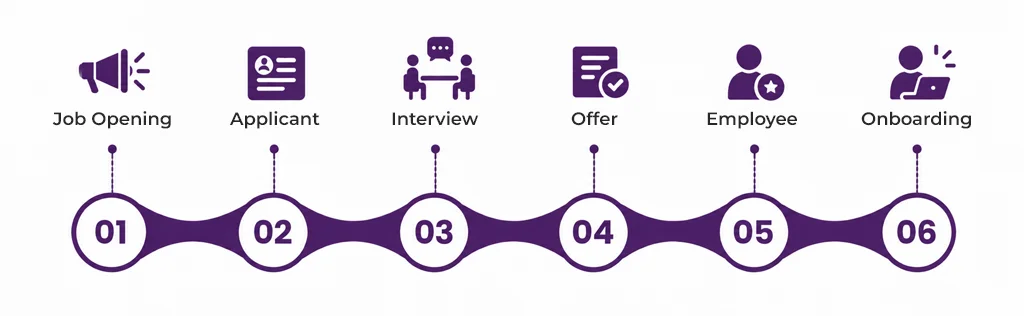
This enables HR to transfer employee data from the recruitment process to the larger employee-management process without any manual effort.
Reporting and Analytics:
To achieve this, management needs to have a view on:
- Employee headcount
- Attendance
- Leave
- Payroll costs
- Recruitment
- Employee performance
- Department-level workforce information
Automated reporting can give management info without having to have HR construct each report.
Why Integrating Payroll and HR Software for Small Business is Crucial:
One mistake is to view HR and payroll as two distinct processes.
Payroll is related to employee information.
Working hours are impacted by attendance.
Leave can have an impact on payroll.
Payroll affects accounting.
That equates to a network that can provide a more secure exchange of information.
HR Process | Payroll/Business Impact |
|---|---|
Employee records | Salary and employment information |
Attendance | Working hours and overtime |
Leave | Payroll adjustments |
Salary structure | Payroll calculation |
Payroll approval | Financial records |
Employee expenses | Cost tracking |
Department | Cost allocation |
An ERP-integrated approach can also connect HR with finance, procurement, inventory, projects, and other business operations.
SowaanERP’s UAE HR core module includes leave and attendance, salary and payroll, recruitment, performance, and related HR functionality.
HR Software and UAE WPS Requirements:
The Wages Protection System (WPS) is an important consideration when selecting payroll technology in the UAE.
WPS is an electronic wage-transfer system overseen through UAE labour-market authorities and approved financial channels. MOHRE’s Labour Market Observatory states that WPS monitors wage payments to help ensure employees receive the correct wages in a timely manner.
For a small business, the practical objective is to have a payroll process that can accurately prepare the required salary information and reduce manual errors.
When evaluating software, ask:
- Can payroll information be structured for WPS processing?
- Can salary components be configured accurately?
- Can payroll changes be reviewed before approval?
- Can payroll records be reported easily?
- Does the vendor provide UAE-specific implementation support?
WPS requirements can vary according to the employer and employee circumstances. Businesses should verify their specific obligations with MOHRE or an appropriate UAE adviser rather than relying solely on software marketing claims.
HR Software and Emiratisation:
For eligible UAE private-sector businesses, Emiratisation is another workforce-management consideration.
MOHRE has established Emiratisation-related requirements and targets for certain private-sector establishments, including businesses within specified employee-count and activity categories.
HR software can help businesses maintain workforce information and generate reports that support workforce planning.
For example, management may need visibility into:
- Emirati employee numbers
- Workforce composition
- Hiring activity
- Employee categories
- Department-level workforce information
However, software reporting should not be confused with determining legal compliance.
The business remains responsible for understanding the rules applicable to its establishment.
Cloud-Based HR Software vs Traditional Systems:
For small businesses, cloud deployment can reduce the need to maintain HR software infrastructure internally.
With cloud-based HR software, authorized users can typically access the platform through the internet.
Cloud HR Software | Traditional On-Premise System |
|---|---|
Hosted infrastructure | Business-managed infrastructure |
Easier remote access | Often office/network dependent |
Easier scalability | Hardware may need expansion |
Vendor-managed updates | Internal update management |
Suitable for distributed teams | Strong fit for controlled local environments |
A cloud approach can be particularly useful for UAE businesses with employees or branches across Dubai, Abu Dhabi, Sharjah, and other locations.
SowaanERP describes its UAE HRMS as cloud-hosted, with access controls, backups, and remote accessibility. Do not select cloud HR software only because it is accessible online. Evaluate security controls, permissions, backups, support, integrations, and the vendor’s ability to protect sensitive employee information.
HR Data Security for UAE Small Businesses:
HR systems contain sensitive information.
This can include:
- Personal information
- Contact details
- Employment records
- Salary information
- Identification documents
- Bank information
- Leave and attendance history
The UAE’s Personal Data Protection Law provides a framework for protecting personal data and defines obligations around its processing, confidentiality, and privacy.
Therefore, businesses evaluating HR software should ask vendors about:
- Role-based access
- Authentication
- Data encryption
- Backups
- Audit logs
- Data retention
- Data hosting
- Third-party integrations
- Incident-response processes
The goal is to ensure that employees only access the information appropriate to their roles.
How to Choose the Best HR Software for Small Business:
There is no universally best hr software for small business.
The right solution depends on workforce size, payroll complexity, branches, integrations, budget, and future growth.
Before choosing a platform, evaluate:
1. Current HR Processes:
Document how your business currently manages:
- Employees
- Attendance
- Leave
- Payroll
- Recruitment
- Reporting
2. Required Features:
Prioritize the features you actually need rather than choosing software because it has the longest feature list.
3. UAE Localization:
Check whether the solution supports the UAE-specific payroll and workforce processes relevant to your organization.
4. Integration:
Consider whether HR needs to connect with:
- Accounting
- Payroll
- Attendance devices
- ERP
- Banking workflows
- Recruitment
5. Scalability:
The system should support your business as employee numbers and operational complexity increase.
6. Support:
Ask whether implementation, training, troubleshooting, and UAE-specific assistance are available. Don’t watch a product demo, ask the vendor to show you their real HR workflow. Demonstrate to them your employee onboarding, attendance, leave, payroll, approval and reporting needs.
A Few Common HR Software Implementation Mistakes:
No matter how good the software is, poor implementation can result in failure.
Common problems include:
Moving out wrong employee information:
Older spreadsheets can have duplicate or obsolete records. Ensure that the data is cleaned prior to migration.
Creating a new automated process that replaces a broken one:
Avoid simply automating any inefficient process without contemplation.
Skipping Payroll Testing:
Test payrolls prior to implementation.
Over-Customizing:
Excessive customisation can lead to higher implementation costs and make it harder to update in the future.
Poor User Training:
HR groups and managers require hands-on training according to their role.
Ignoring Employee Adoption:
If employees are to use the self service, make it clear and explain the new process. Avoid doing the first live payroll run the first time the system is tested.
What is the time required to implement HR Software?
Implementation time will vary based on:
- Number of employees
- Data quality
- Payroll complexity
- Attendance integration
- Existing ERP
- Customization
- Number of branches
- User training requirements
There’s a difference between a small business with simple needs and a multi-branch business that needs multiple integrations.
A working implementation can go thereafter:
- Process Review → 2. Data Cleanup → 3. Configuration → 4. Integration → 5. Testing → 6. Training → 7. Go-Live → 8. Review
This will minimize disruption and provide HR with an opportunity to head off issues before the first production payroll.
So what is the ROI of HR software for small business?
The ROI of HR software is mostly in minimizing administrative hassle and increasing process reliability.
Businesses can measure:
- HR hours saved
- Payroll processing time
- Number of corrections to payroll.
- Employees use self-service to request and receive assistance with their personal issues
- Time devoted to reports preparation
- Attendance reconciliation time
- Recruitment processing time
For example:
Current HR administration cost
minus
The savings in post-automation HR administration costs.The cost savings from post-automation HR admin.
The cost savings from can be one basis point of operational savings.
Other benefits may include improved reporting, quicker approvals, reduced manual errors and greater access for employees to information. Analyze your existing process prior to implementation. Without a clear understanding of how much time your team devotes to payroll and HR duties now, it will be hard to prove the true relevance of automation in the future.
Why Sowaan ERP for Small Business HR in the UAE?
Sowaan ERP is more than just an HR system; it’s a business solution that integrates HR with the rest of the business.
Its UAE HR and payroll solution integrates employee management, attendance, leaves, payroll, employee self-service, reporting, multi-currency payment options and workflows.
HR can also be integrated with other business processes like finance, inventory, procurement, CRM, project management, and other functions in the wider ERP system.
This is significant to a small business as it expands.
An employee record and payroll are the basic data that a business might require to start out. Later, it may need:
HR → Payroll → Accounting → Projects → Procurement → Inventory → CRM
There is no need for a bunch of scattered systems to make that happen, as an integrated ERP can offer the foundation for the expansion.
Ultimately, the ideal HR software in UAE for businesses will depend on the company’s size, compliance requirements, integrations, budget, and growth goals.
In conclusion:
HR software should not add to the complexity of a small business.
It should be able to take it off.
The right platform can provide all employee records, attendance, leave, payroll, reporting and employee self-service in one coherent setting and offer the basis for future growth.
UAE local workflows, WPS requirements, workforce management challenges (Emaratisation), data protection, security, and accounting and ERP system integration should also be taken into account when selecting for UAE businesses.
The goal is simple:
Less manual administration. Better visibility. Better managed HR processes.
The HR system ought to grow as the business expands. Manage employees, attendance, leave, payroll, and HR workflows from one integrated platform built for growing UAE businesses.
Ready to Simplify HR Management?
FAQs
HR software is an online application used to manage, automate and consolidate employee management, attendance, leave, payroll, recruitment, reporting and more.
HR software can help small businesses cut down on repetitive HR administration, maintain a centralized employee record system, streamline payroll processes, and offer greater access to HR services for the employees.
Yes. Many HR platforms integrate attendance and payroll processes so that payroll can be based on relevant attendance data.
Yes. Even for small businesses, particularly when HR-related manual tasks are taking up a lot of time, HR automation can be of great benefit, even in relatively small teams.
There are some HR and payroll solutions that are tailored for the UAE that provide support with the WPS process. It is important to check the particular skills and needs of the business.
HR software can categorize information on the workforce and offer reports for the purpose of workforce planning and monitoring related to Emiratisation. The legal requirements should be checked by businesses individually.
While cloud HR software can offer robust security measures, the security is largely dependent on the architecture, configuration, access controls, backups, encryption, and data management practices of the HR software provider.
Yes. HR systems integrated with ERP can link payroll and financial data related to the employees to accounting and other business processes.
There are several factors that will determine how this is implemented, such as the number of employees, the quality of data, payroll complexity, integrations, customizations, and training. An easy to implement small business solution can be significantly simpler than a multi branch solution.
Search for UAE localizations, payroll and attendance features, employee self-service, security, integrations, scalability, reporting, ease of use, implementation support and total cost of ownership.