
Custom ERP solutions help organisations connect these functions with a uniform enterprise resource planning system that complies with their operational requirements. Instead of fully relying on predefined workflows, companies configure or develop ERP software to support their specific processes, reporting requirements, and integrations.
The right approach for companies at Dubai, Abu Dhabi, Sharjah. Other business centres in UAE depends on the size of their facilities, industries, budget and technologies. Whereas some organizations have completely adapted ERP systems, others can achieve their goals by adapting the chosen ERP platform.
This guide explains how to operate custom ERP software, prioritizes businesses with respect to development costs; how long it will take to implement it, and how to select a ERP software development business from UAE.
Companies exploring enterprise resource planning options can also visit SowaanERP for more information about ERP software and business management solutions.
Custom ERP solutions link business functions such as bookkeeping, inventory, acquisitions, sales and HR to one comprehensive system. They can improve reporting, automate different tasks, and help companies expand. The paper’s main focus is the measurement of investment, including the need to assess the quality of existing ERP platforms, such as development costs, implementation timelines, operational requirements and capacities.
What Are Custom ERP Solutions?
Custom ERP solutions are enterprise resource planning systems adapted or developed to the specific operational requirements of the company. They enable departments to share business information and coordinate processes rather than produce individual spreadsheets and separate application records.
A customized ERP system can be developed with financial management, inventory control, purchasing, customer relationship management (CRM) staff, wage administration, production, project management and industry specific workflows.
A UAE trading company that operates multiple warehouses may therefore require automated transfer of shares, supplier approval workflows, landed cost calculations and consolidated financial reporting. A standard ERP platform may already retain more of these functions, however it may need further configuration or design to meet the company’s needs.
Custom ERP software can address these vulnerabilities with configuration, extensions, or purpose-built modules.
It is important to understand that ERP Custom Set up isn’t always around developing a whole platform from the ground up. Enterprises often have the possibility to adjust the current ERP only to their missing functionality.
Custom ERP Software vs. Off-the-Shelf ERP
The enterprises should compare the custom ERP software with platforms which are created with Ready before the best approach is taken to address their needs.
Factor | Custom ERP system | Off-the-shelf ERP |
Functionality | Tailored to specific business workflows | Provides predefined business functions |
Initial investment | Can be higher for extensive development | Often lower for standard requirements |
Implementation | Depends on scope and complexity | May be faster when standard features are sufficient |
Flexibility | High, depending on architecture and agreement | Depends on available configuration and extensions |
Maintenance | Requires an agreed development and support arrangement | Core maintenance is generally handled by the vendor |
Integrations | Can be developed for specific applications | Depends on supported connectors and APIs |
Upgrades | Custom components need to be maintained | Core upgrades are generally managed by the vendor |
Ownership | Determined by the development contract | Governed by licensing and vendor terms |
Compare is at least three practical approaches: the ERP standard chosen configurable ERP and the entire tailor-made standard. Evaluation on the basis of the same requirements, budget, plan of implementation and ownership cost over the period of three to five years.
For standard accountants, inventory and marketing companies there might be a sufficiently ready platform. Organisations with specific workflows and complex integrations can provide more tailor-made for their approach.
When Does Business in UAE Want to use Custom ERP?
Not all organizations require their own development. As existing systems are unable to support mainstream business processes without a manual or complex solution for performing extended tasks, a more specifically developed ERP solution becomes more attractive.
Consider a custom ERP system if your business experiences the following challenges:
- Disconnected applications: Accounting, inventory, purchasing and sales use separate systems that do not exchange information reliably.
- Complex approval workflows: Purchases, expenses, orders or payments require multiple approval levels.
- Specialized operations: Manufacturing, construction, distribution or other activities involve processes that standard software cannot adequately support.
- Multi-branch management: Management needs consolidated reporting across branches, warehouses or legal entities.
- Repeated manual work: Employees regularly transfer data between spreadsheets and different business applications.
- Limited reporting: Managers cannot obtain accurate performance information without manually combining several reports.
- Integration limitations: Existing applications lack the connectors or APIs needed to exchange essential data.
- Expansion requirements: New branches, products or business units require capabilities the current system cannot provide efficiently.
For example, construction company project subcontractor tracking costs, as well as benchmarks and retention management, could be needed. Purchases, delivery of stock, vendor management and customer order fulfilment are a company priority.
Its functionality is necessary in order to define the ERP approach, rather than assume that a growing enterprise requires a fully custom platform.
Document repeats operational problems prior to contacting ERP providers. Consider the hours spent doing manual labor, the number of mistakes that have been made and what the hard tasks are to make. The results will help prioritize the features and evaluate the benefits that you could take.
What Features Should Custom ERP Solutions Include?
The proper feature set will depend on the industry of the company, size, and workflow. But most businesses should of the growing proprietary ERP software are given good results through the following modules.
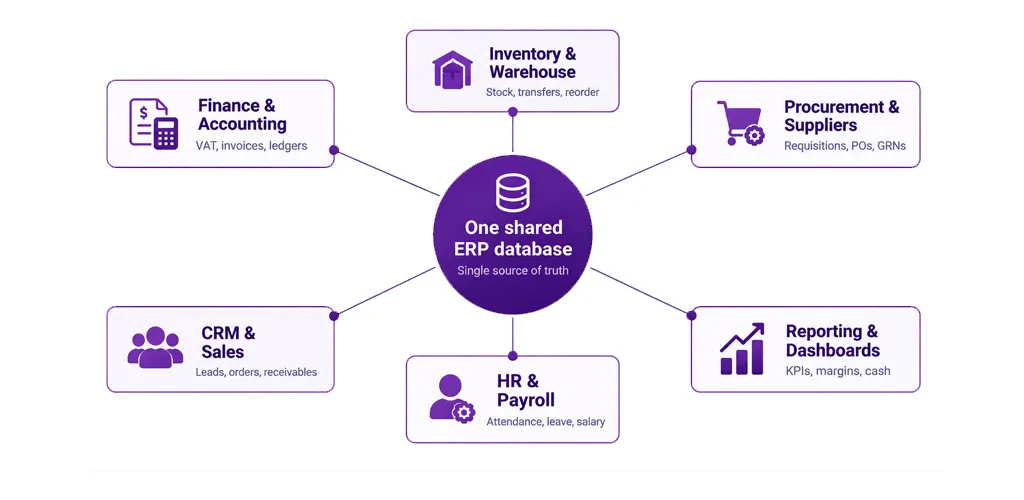
1. Financial Management and Accounting
The Financial Module should support general accounts, accounts, claims, expenses, bank accounts and accounting module.
UAE businesses should encompasses VAT, tax invoice workflows, the calculation of the tax and reporting requirements for their operations.
To assess applicable requirements, check UAE Federal Tax Authority resources for VAT. Automation of Accounting can help with tax collection, but not ensure compliance. Companies were still responsible for the exact accounts, the correct management of taxes and the timely provision of data.
2. Inventory and Warehouse Management
The inventory will enhance visibility of the inventory, deposits, transfers, acquisitions, purchases and reorder levels.
Additional features can be used depending on the company: barcode scanning, consignment tracing, serial numbers, ageing and inventory valuation at the warehouse level.
For instance, the distributor and its individual stores require accurate information on the availability or unavailability of stocks at each location. Integrating inventory into sales and purchase can help improve replenishment decisions and reduce data input overlap. The accuracy of The of the main Establish inventories; the frequency of changes to inventory; and order fulfilment times for implementation. By comparing these post-start indicators we will help evaluate whether the new ERP system has undergone significant improvements.
3. Procurement and Supplier Management
The procurement module may consist of purchase requisitions, suppliers, offers, orders, delivery notifications and seller receipts.
Approval workflows will assist in ensuring that procurement processes are based on business policies. Complementary functionality may include the reporting of supplier performance, contract data and allocation of landed costs.
Integration of procurement and inventory with accounting enables financial groups to compare quotations, product revenues and vendor invoices.
4. Customer Relationship Management and Sales
CRM helps customer and sales teams keep customer profiles, record messages, and manage demand and supply.
Where CRM is linked with ERP the authorized order can be executed manually in inventory and finance processes without any repeated import. The management can also compare sales, unpaid debt and order fulfilment for teams.
5. Human Resources and Payroll
HR functionality can consist of information about personnel, attendance, holiday application, recruitment, performance management and salary preparation.
The UAE was asked to undertake an assessment of its employment, wages and business agreements with recordkeeping requirements workforce. Provider explains which links are supported and how to support them when ERP is to be integrated into external payments or public services.
6. Reporting, Dashboards and Business Intelligence
Dashboards shall specify supervision management requirements, including revenues, gross profits, unpaid bills, inventory revenues, purchase costs, order fulfilment and project return.
The association with ERP could shorten the consolidation period of the Department reports. But the reporting’s quality will still depend on precise data, consistent processes and well defined KPI calculation. Avoid only because it is available for adding modules. Priority shall be given to functions that have been designed to respond to current business challenges and the added potential of business requirements.
How Custom ERP Solutions Support UAE Compliance and E-Invoicing
Taxes and recordkeeping requirements issues should be taken into account in the planning for ERP, rather than subsequent considerations.
The UAE entities were required to submit the financial data and comply with VAT. The UAE Ministry of Finance also introduced a tiered National electronic invoicing programme which was based on the Peppol framework, based upon implementation requirements consistent with relevant business categories and schedules.
Enterprises must be made aware of the official electronic invoicing announcements through UAE Department regarding the official Finance and the Federal Tax Authority resources for tracking the implementation of recent requirements.
When evaluating custom ERP software UAE businesses should ask whether the proposed solution can:
- Maintain accurate invoice and transaction data.
- Support relevant VAT calculations and tax reporting workflows.
- Integrate with the applicable electronic invoicing architecture and an appropriate Accredited Service Provider, where required.
- Preserve invoice records, transaction histories and audit trails.
- Handle corrections, credit notes and relevant exception workflows.
- Exchange data securely with connected accounting and business applications.
Avoid only because it is available for adding modules. Priority shall be given to functions that have been designed to respond to current business challenges and the added potential of business requirements.
How Long Does Custom ERP Implementation Take?
On the size and complexity of the project, implementation’s time depends. A focused multi-module solution can be achieved faster than multi-service platforms, comprehensive integration processes and historical data migration.
The next series will be indicative planning forecasts, not safe delivery times.
Project scope | Illustrative timeline | Typical requirements |
Limited-scope ERP | 2–4 months | A few modules, straightforward workflows and limited migration |
Mid-sized ERP implementation | 4–9 months | Several departments, integrations, reporting and user training |
Complex enterprise ERP | 9–18 months or longer | Multiple entities, specialized workflows and extensive integrations |
The actual timeline should be confirmed after requirements discovery and technical assessment.
The Main Stages of ERP Implementation
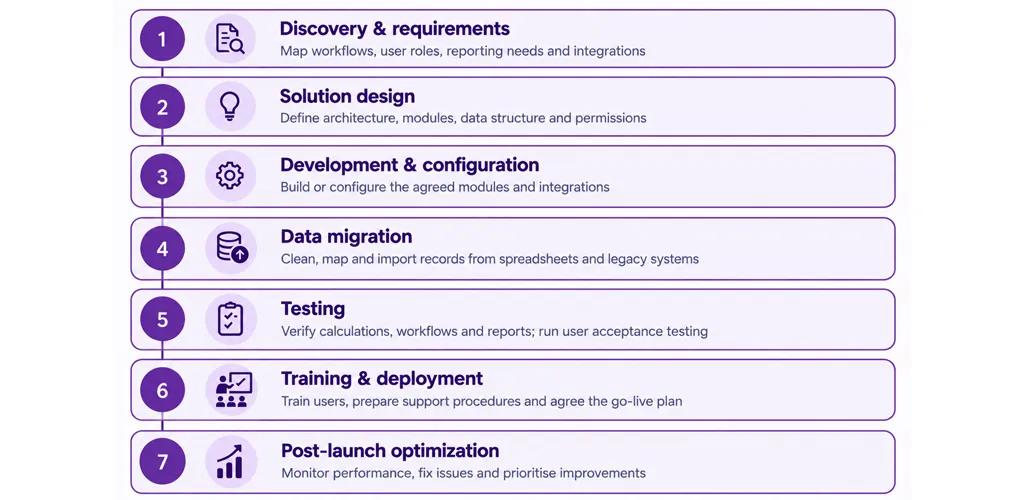
- Discovery and requirements gathering: Document existing workflows, business problems, user roles, reporting needs and integration requirements.
- Solution design: Define the architecture, modules, data structure, access permissions and implementation scope.
- Development and configuration: Build or configure the agreed functionality and develop required integrations.
- Data migration: Clean and map records from spreadsheets, legacy systems and existing applications before importing them.
- Testing: Verify calculations, workflows, permissions, integrations and reports. Conduct user acceptance testing with employees who understand daily operations.
- Training and deployment: Train users, prepare support procedures and agree on a go-live plan.
- Post-launch optimization: Monitor performance, resolve issues and prioritize improvements based on actual usage.
Do not set a launch date based only on development estimates. Data quality, delayed approvals, integration dependencies and employee availability can affect delivery. Agree on milestones and acceptance criteria before development begins.
Cloud-Based vs. On-Premises Custom ERP Software
Businesses planning ERP software development in Dubai and across the UAE should assess how the system will be hosted, secured and maintained.
Consideration | Cloud ERP | On-premises ERP |
Infrastructure | Hosted on a cloud platform | Hosted on company-managed infrastructure |
Initial infrastructure cost | Often lower | Can require significant upfront investment |
Access | Remote access with suitable connectivity and controls | Depends on network and access configuration |
Maintenance | Shared between provider and customer under the agreement | Greater responsibility for the company’s IT team |
Scalability | Capacity can often be adjusted as needs change | Expansion may require additional hardware |
Control | Depends on hosting, architecture and contract | Greater direct infrastructure control |
Business continuity | Depends on provider resilience and recovery arrangements | Depends on internal infrastructure and recovery arrangements |
The ERP Cloud can stimulate a company to reduce infrastructure’s management. Such approaches may be appropriate for organisations that can have technical, contractual or operational constraints on the ground or hybrid approaches.
Neither option is automatically safer. For evaluation of encryption, authentication, access control, back-up monitoring and error response disaster recovery.
Information Undertaking Primary Data Safety Services will also evaluate the Government data protection handbooks and set operational requirements for UAE. Ask of provider responsible for backup, disaster recovery, security updates and system surveillance. To show how quickly the system can restore failures and how often recovery methods will be tested.
How to Choose an ERP Software Development Company in UAE
As supplier technology and supply process may affect the system over the years, the choice of the ERP partner is important.
In case of development of an ep-in-nae software enterprise the following factors shall be assessed:
1. Industry and Workflow Experience
Please ask the vendor whether you know which sector of your business is involved, or if you can show us the business processes you are involved in. If there is a company offering this, the enterprise can demand the calculation of materials, production planning and quality control. A company may prioritise purchasing, warehousing and placing.
2. Clear Requirements and Project Scope
The criteria for inclusion, achievements, steps, acceptances and exclusions will need to be identified in these proposals. I wonder how these changes will affect the schedule for costs and supplies when implementing the agreements.
3. Technical Architecture and Integration
Discussions on the APIs data structure; scale, testing and integration. The architecture has to support future changes without undue relation between the developer or supplier.
4. Data Security and Access Controls
Because you protect confidential information that will have access to a back-up test. What’s going to happen in a security incident. Confirm hosting arrangements, restoration targets and current contractual obligations.
5. Training, Documentation and Support
The contract will consist of training, technical documentation, maintenance purposes, response times and improvement.
6. Ownership and Exit Arrangements
Identify who owns the specified user code, configuration, document, and other project deliverables information. If the Provider has intellectual property or a third-party license, the restrictions will be known. Please confirm how your data can be exported from other suppliers after a later switch.
7. Demonstrations and References
Request a demonstration of workflows similar to your business processes. Request information on customers and evidence of the experience of a service provider as a part of a similar project. Ask Shortlist Supplier to prove the same 3-5 business workflows. Use the common checklist to evaluate functionality, integration, security, implementation, support and common costs. This allows for objective comparison of proposals.
Common Risks in Custom ERP Projects and How to Reduce Them
Specific projects within the ERP can be in a difficult situation where companies start their development without the work that is generated by the transformation of established processes being either clear or underestimated.
The following risks deserve particular attention:
- Uncontrolled scope changes: Document priorities, assess change requests and obtain approval before expanding the agreed scope.
- Poor data quality: Clean duplicate, outdated and inconsistent records before migration, then reconcile important balances after importing them.
- Insufficient user involvement: Include employees from finance, operations, sales and other relevant departments during design and testing.
- Inadequate testing: Test realistic scenarios, exceptions, permissions and integrations before launch.
- Weak adoption: Provide role-specific training, communicate process changes and establish a clear support process.
- Unclear ownership: Document intellectual property, access credentials, source-code arrangements and exit procedures.
- Unplanned maintenance: Budget for infrastructure, security updates, upgrades and ongoing technical support.
- Over-customization: Avoid rebuilding features that an established ERP already handles effectively unless there is a clear business reason.
How to Measure Custom ERP ROI
The total share of ERP investments should be valued using measurable performance instead of guaranteed economies.
Start by recording baseline performance before implementation. Depending on your priorities, useful metrics may include:
- Time required to prepare monthly financial reports.
- Hours spent on manual data entry and reconciliation.
- Inventory discrepancies and stock adjustment frequency.
- Order processing and fulfilment times.
- Purchase approval turnaround times.
- Outstanding receivables and overdue invoice levels.
- Frequency of duplicate records and reporting errors.
- System availability and support costs.
On recapitulate reports, for example, if a company spends 200 hours a month. ERP reduces the costs and facilitates the measurement of time savings based on the real costs of the labour of the company. Other potential benefits include reducing stock errors, increasing the speed of decision-making and raising the awareness of operational costs.
A simple ROI calculation is:
However, the overall quantitative benefits of ROI (%) (ERP) * ERP costs × 100 are used to combine the same benefit and the cost assessment period. Includes implementation and migration costs, ongoing support, reception, training and the duration of the internal project. Avoid double counting of same benefit or see expected savings as a guaranteed outcome.
How AI Is Changing Custom ERP Solutions
Artificial intelligence can help improve ERP function which will enable groups to analyze data through operations, identify maps, and automate individual issues. In connection with the integration and monitoring of the system automation decisions, these will be useful in relation to the quality of the data they are subject to, and.
Potential applications include:
- Demand forecasting: Analyze historical sales and relevant data to support inventory planning.
- Anomaly detection: Flag unusual transactions, unexpected stock movements or discrepancies for human review.
- Workflow automation: Route requests, classify documents and assist with repetitive administrative tasks.
- Management insights: Help users explore trends in sales, expenses, purchasing and operational performance.
- Customer support: Support internal teams with searchable business information and approved response workflows.
The AI recommendations have to be validated before the Finance, Operating and Compliance Decision. Enterprises should assess data privacy, privileges, accuracy and poor performance’s impact.
AI does not automatically or correctly comply with ERP. Audit of significant outputs that are based on source data and applicable requirements, particularly financial reporting, customer information or tax decisions.
Introduce AI which addresses measurable business issues such as repetitive document processing, or expected demand for Establishing methodologies for evaluating and assessing human results before developing other automated workflows.
Prepare Your Business for the Next Stage of Growth
A ERP adaptive solution would help UAE companies build inter-divisional networks, raise accountability and increase harmonized operational processes. The question of creating a whole new system is not necessarily the right solution. It meets the basic needs of the company and will be further managed over time, safely and cost-effectively.
Before choosing the service provider, you shall record your ongoing tasks, place the priorities in the required modules, evaluate the requirements for integration and conformance and calculate the overall costs of the owners. Staff involved shall operate the system daily and shall establish measurable performance criteria before development commences.
For companies looking for custom RP software uae options the next step is to compare appropriate solutions with actual operational requirements rather than selecting a platform that is based on functionality only.
Explore SowaanERP to learn more about its ERP offering and contact the team to discuss your business management needs.
FAQs
A custom ERP solution is a Enterprise resource planning system designed or changed according to the company’s specific workflows. It can link the accounting, inventory, acquisition, distribution, HR and other business functions to common data and complex processes.
The costs vary from modules and complexity to workflows, integration, data migration and security requests, to up to date support. If you need a well-explored service, then you need to compare the total costs of the owner over 3 to 5 years instead of concentrating on the initial development fee.
The scope, however, is limited, and although project medium-sized or complex project could take far longer, project implementation could take months. Timeliness depends on the requirements, data quality, integration, testing, availability of users and implementation strategies.
Yes, for a company’s particular needs, which cannot be addressed cost-effectively by existing products. Small enterprises, however, are prepared to use standard invoices, invoices and inventory workflows for the delivery of more affordable and user-friendly ERP.
Yes. Integration can be performed via a connection APIs, a reference connector, a file exchange and other methods. An application’s feasibility depends on the quality of the integration interface, existing applications, access rights, data formats and quality of applications.
It may be designed or constructed to support suitable electronic invoicing workflows and suitable integration systems. The undertakings shall assess whether the solution complies with the technical requirements which are imposed by them and, where appropriate, may tie it to the Accredited Service Provider that they refer to. ERP will not guarantee its own fulfilment.
ERP clouds can lower infrastructure’s original costs, simplify its scale and further increase control of infrastructure in on-premises . Compare hosting, subscriptions, employees, safety, backup, repair, maintenance costs over the anticipated lifetime of the system.
Common risks include unclear requirements, magnitude changes, low data quality, integration problems, inadequate testing, user resistivity and vague care. The risk reduction can ensure the project’s scope, the realistic budget, the gradual implementation and active involvement of users.
Yes, if the architectural and planning requirements match account scalability requirements It is essential to assess the system with respect to additional users, offices, storage facilities, maintenance activities, integration and reporting requirements until a significant increase has been achieved.
The property of Each Third Party shall be subject to the development agreement, intellectual property rules and any part of its ownership. Ownership rights and licences of relevant codes, documents, configurations and related shipments should be determined prior to the signature of the contract in the Company.
Ongoing support may include error correction, security improvement, backup, efficiency monitoring, technical integration services, user support, and enhancement of functionality. The agreement covers service levels, commitments, charges and increase of expenditure.
Assessment of relevant experiences, technological architecture, needs analysis, capacity for integration, security, project management, documentation, support and mandate. Request a demonstration and compare your suggestions to the same documented requirements.