
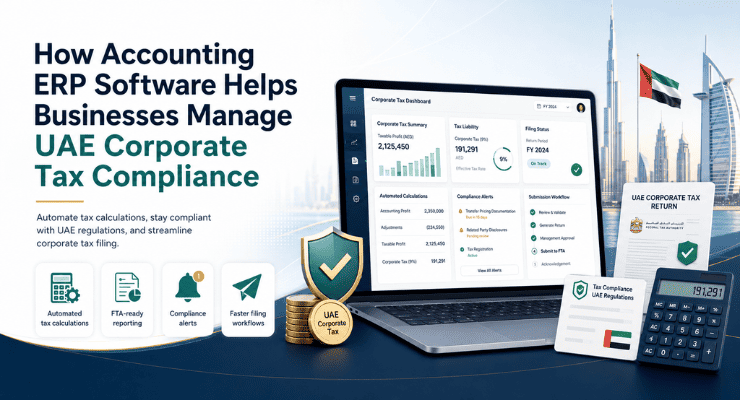
The introduction of corporate tax in the UAE is proving to be a turning point in how businesses are managing their finances, reporting, and compliance requirements. While the UAE has been popular as a global business hub due to its favorable tax environment for a long time, organizations are now required to adapt to structured corporate tax compliance and adhere to the stringent rules of bookkeeping.
Many organizations, particularly those that still rely on spreadsheet accounting and manual processes, are finding tax compliance a tedious and error-prone task. This is where accounting ERP software UAE solutions come into play.
Modern ERP solutions can be of great help in automating accounting processes, maintaining accuracy in records, producing tax ready reports, and ensuring that all regulatory and compliances are met. In this article, we will analyze how accounting ERP software eases corporate tax compliance and helps UAE businesses remain ready for the future.
UAE Corporate Tax Is Here: Are You Ready?
The corporate tax regime is a big step for businesses operating throughout the UAE, and it’s fundamentally changing accounting practices. Businesses must maintain clear books of accounts and accurate calculation of taxable income according to specific tax regulations.
As more and more businesses realize the inadequacy of their manual accounting systems, relying on multiple disconnected spreadsheets and manually prepared reports is posing a risk.
Accuracy and proper record keeping can lead to significant challenges during audits, financial reviews, and while filing taxes. Consequently, businesses across all sectors are opting for robust ERP solutions to automate accounting processes and streamline compliance.
An ERP system provides a central repository where all financial data, invoices, expenses, pay-roll information and reporting tools are brought together under a single umbrella, thus laying the foundation for effective tax compliance.
What UAE Corporate Tax Means for Your Business Accounting:
Corporate tax is not just an end-of-year accounting chore. It’s influencing your day-to-day accounting, record keeping, financial reporting, and business decision making.
Businesses must ensure that:
- Transactions are properly recorded.
- Expenses and revenue are correctly classified.
- Taxable income calculation is accurate and reliable.
- All necessary supporting documentation is readily available.
- Financial reports are produced in line with regulations.
- Financial data is retained for mandated periods.
Gathering and reconciling all these elements manually can be overwhelming when you do not have a formal accounting system.
The companies that previously worked with manual accounting are quickly learning that precise and transparency standards are more than necessary now and real-time visibility of the financial status is critical.
This is one of the main reasons why organizations are now seeking corporate tax UAE ERP software to bolster their accounting operations and reduce compliance risks.
Common Corporate Tax Filing Challenges Without ERP:
When filing corporate tax without ERP solutions, manual accounting system users typically encounter several obstacles:
Data entry errors:
Manual entries are inherently more prone to human errors than automated processes. One minor error can have cascading effects on the reports and ultimately on the taxable income computation.
Disconnected financial information: When accounting data is scattered across numerous spreadsheets and applications, it is often a challenging and time-consuming process to combine and compile the data to create comprehensive financial reports and returns.
Delayed financial reporting:
Accurate and timely access to financial data is vital for tax compliance. Manual reporting procedures usually result in delays.
Lack of audit readiness:
Tax authorities have the right to request for supporting documents and detailed transactional histories of all financial activities. This is where central data storage comes in handy, otherwise manual tracking would make things problematic for your organization during the audit process.
Difficulty tracking expenses:
Accurate categorization of expenses is an important part of correct tax calculations. Manual systems often fall short when it comes to proper expense tracking.
Compliance risks: Tax laws and regulations can change over time and, without adequate software, it may be difficult for businesses to stay updated and compliant.
These issues can add considerably to the workload as well as expose companies to financial losses in the form of fines and reporting errors.
How Accounting ERP Software Automates UAE Corporate Tax Compliance:
Modern FTA compliant accounting software UAE is designed to take on many tedious aspects of tax compliance through automation of the essential accounting functions.
Automated Financial Record Management:
An ERP system automates the process of capturing and organizing financial transactions from various business activities. The result is decreased manual labor and an improved level of data accuracy.
Centralized bookkeeping offers clear and instant access to the business’s financial position.
Accurate Tax Calculations:
A key benefit of UAE corporate tax software with regards to tax is automatic tax calculation.
The ERP software calculates all financial details using a set of accounting rules, thereby avoiding the use of spreadsheets and complicated formulas. This contributes to accuracy and reduces calculation errors in reports.
Real-Time Financial Reporting:
ERP solutions prepare immediate financial reports. Some of the most useful include:
- Profit and loss statements
- Balance sheets
- Cash flow statements
- General ledger reports
These reports provide instant insights for both tax purposes and to aid the understanding of financial performance.
Centralized Document Storage:
When it comes to tax compliance, there are often required supporting documents like contracts, invoices, receipts, and payment records to keep readily available.
An ERP for tax compliance UAE solution enables users to digitally store and retrieve these documents at any point, ensuring effortless audits and easy access.
Enhanced Compliance Monitoring:
Modern ERP software helps organizations to monitor compliances through automatic work flows and approval process which allow finance teams to rectify discrepancies and keep the entire bookkeeping procedure smooth and correct year-round.
Better Audit Readiness:
ERP systems produce the audit trail of all financial transactions that have ever occurred, the full transaction history of every financial movement in your business, recorded digitally and stored in a highly secure manner. This will help ease audits and inquiries as needed.
Multi-Department Integration:
Accurate accounting data for corporate tax compliances relies on information from various departments. An ERP system integrates:
- Accounting
- Sales
- Procurement
- Inventory
- Payroll
- Human resources
This brings the entire organization on a single page by removing any data silos between departments.
Key Features to Look for in a Tax-Ready Accounting ERP:
Before adopting an ERP solution to your business, it is essential to ensure that it has the capability to fully automate your tax compliances. A well implemented ERP system provides several benefits:
Automated Accounting Processes:
The most fundamental requirement from any accounting software solution that can automate your tax compliance is that it should be designed to automate most if not all the basic accounting functions such as:
- Journal Entries
- Invoice Processing
- Expense Tracking
- Bank Reconciliations
- Financial Reporting
Reporting focused on compliance:
ERP solutions must provide accurate financial reports that satisfy tax submission and regulatory requirements.
Audit trail functionality:
A complete audit trail reduces complexity and enhances accountability by keeping a record of every financial transaction in the ERP system.
Document Management:
Storing documents within the ERP helps businesses retrieve and access records when necessary.
Real-time Dashboards:
Customizable dashboards offer financial managers and business executives full visibility of their financial performance in real time.
Scalability:
As businesses grow and expand, accounting requirements become increasingly complicated. A scalable ERP can be adjusted to new demands, without requiring new system implementations.
Cloud Accessibility:
ERPs hosted in the cloud allow businesses to safely access their financial information from any location, facilitating work teams in different offices and home locations.
Integration Capabilities:
The ERP should be capable of integrating seamlessly with banking solutions, payroll systems, inventory management systems, and other business applications.
Those looking to find a reliable ERP system to manage taxes, UAE organizations should prioritize these features for long-term compliance and productivity.
Conclusion:
Businesses in the UAE now face new financial duties thanks to the introduction of corporate tax. Organizations need to keep their records, manage accurate financial reports, and abide by regulations.
It is difficult for manual accounting systems to respond to these demands effectively. Poor record keeping, a lack of reporting on time and disparate financial information may prove problematic during tax preparation and filing.
Accounting ERP software in UAE provides a simpler solution for ensuring compliance. Automating accounting activities, gathering all financial records, and producing exact financial statements may help businesses reduce risks, improve productivity, and remain ready for future regulatory changes.
The evolving business landscape is shaped by new corporate tax laws. Implementing a dependable ERP system can establish the required foundation for sustained success and compliance.