
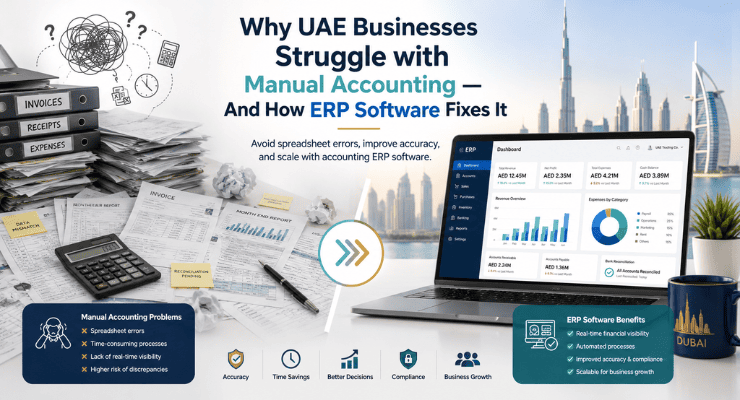
It is now more crucial than ever for UAE businesses to manage finances efficiently. The growing complexities of VAT regulations, corporate tax laws, competitive environment and customer expectations mean it is simply no longer sustainable to stick to manual accounting processes. Yet, a large number of businesses still rely on spreadsheets, paper documents and manual accounting.
Manual accounting might seem less expensive initially, but it will surely result in high costly mistakes, delays, and compliance risks as well as inefficiencies. These factors will only grow as the business expands. It is for this very reason why many organizations are opting for accounting ERP software UAE solutions that allow them to automate financial processes, improve accuracy and access real-time financial insights.
This article will analyze the challenges that come with manual accounting and how the ERP software allows UAE businesses to overcome them.
The hidden costs of manual accounting for UAE businesses:
Most small and medium sized businesses use spreadsheets as they are convenient and economical, however it becomes problematic as the transaction volume increases.
Accountants then have to spend hours inputting invoices, reconcile accounts, update financial information and prepare financial reports. This means valuable time is not being spent on financial strategic planning.
There are also informational silos when the data becomes fragmented between spreadsheets, emails and paper files; making it difficult to access it in time. This leads to lack of efficiency and more costs incurred, and less visible on what is going on.
As the rules in UAE grow, so does the need for efficient financial system which not only focuses on compliance but also strategic decision making, but manual accounting will never achieve that.
Challenges faced by UAE businesses with manual accounting:
Errors due to human intervention and data entry mistakes:
Manual accounting relies heavily on human effort, and every accountant is bound to make a mistake at least once, whether it’s entering a wrong figure, duplicate entries, or failing to record certain transactions.
Time consuming financial processes:
Bookkeeping is a laborious task involving recording transactions, producing invoices, reconciling bank statements, managing payments to creditors and receivables to customers, and producing financial reports on a monthly/quarterly basis. This hinders the overall workflow and finance personnel are so consumed in repetitive tasks that there is no time left to strategize and analyze business processes and their performance.
Maintenance of records and accuracy challenges:
As the data becomes multi user driven in spreadsheets or paper documents, it is nearly impossible to maintain synchronized financial records; more especially when departments might not know who made the most recent change. With lack of centralized system access, even for management, current data is difficult to obtain and thereby making business decisions more difficult.
Lack of financial visibility:
It is necessary for every business owner to know their cash flow, expenses, revenues and profits accurately to have a close eye on their business’s performance. However manual systems present an outdated financial view since information isn’t updated on a real time basis; the consequence being realizing an issue only when it becomes too late.
Lack of Scalability:
As the business expands by opening new branches, hiring employees, and increasing the volume of transactions, managing accounts with the help of manual system becomes an extremely inefficient, challenging and costly process. This means more staff would have to be hired in the accounts department, increasing operational costs tremendously.
Compliance risks:
The UAE requires businesses to accurately maintain their records and submit accurate tax declarations to avoid penalties and fines, which can lead to both financial and reputational losses. It is very hard to maintain accurate and up-to-date records, obtain the required reports for audits, and perform accurate tax calculations without any system.
Why manual accounting is an added risk for UAE businesses in this day and age:
Several reasons contribute to increased risk while doing manual accounting in the UAE:
UAE VAT requirements:
Accurate reporting and VAT calculation for the UAE are a major concern. Manual systems carry a high risk of missing tax, false declaration, delay in reporting, or incorrect tax calculation, which can result in financial penalties.
Corporate Tax Compliance:
With the implementation of Corporate Tax in the UAE, businesses are expected to precisely maintain records and financial statements of their profitability and expenditure, in order to accurately calculate tax, thereby requiring efficient and integrated financial systems.
Increased Competition in the UAE business market:
With the increased competition among businesses in the UAE, rapid and accurate decision making and smooth operations are essential to outrun others. Businesses using manual accounting processes are less efficient when it comes to quickly reacting to market changes because it does not have access to real time financial information compared to those using ERP software UAE.
The expectation of digital transformation:
Digital transformation is one of the goals in the UAE. Businesses are expected to adopt efficient systems to simplify various operations, increase transparency and ensure compliance. Not having such system is putting the organization at a disadvantage over its competitors.
How accounting ERP software addresses these concerns:
Modern accounting ERP solutions are well equipped with features such as automation, accuracy, and real time visibility that are beyond the scope of traditional manual systems.
Automated data entry:
The system automatically captures and records financial data, hence reducing the work of manual data entry significantly and eliminates all the common errors that may be caused due to it while ensuring consistency throughout. It saves the employees’ time from repetitive data entry tasks enabling them to concentrate on financial analysis of the business.
Real time financial reporting:
The prime advantage of cloud accounting UAE solutions is providing the financial reports on a real-time basis. Businesses will have the ability to monitor cash flow, revenues, expenses, profit, overdue invoices and tax liability accurately to enable quick and sound decision making.
Improved accuracy:
With automated calculations provided by the ERP software, there is reduced risk of calculation errors and ensures consistency and up-to-date financial reports are available across all departments thereby inculcating a sense of security in reporting and strategic decision making.
Support for VAT and corporate tax compliance:
With advanced integrated ERP solutions, tax compliance within the UAE’s regulations is no longer a concern, with its automatic calculation of tax and financial statements. The software helps business reduce compliance risks by tracking all relevant transactions and producing accurate tax reports required. An ERP system significantly eases administrative burden with its capabilities of providing an audit trail of all transactions, helping businesses enhance their compliance strategy.
Centralized financial management:
Instead of managing various spreadsheets, the accounting ERP system consolidates all financial information into a central platform making all data accessible through a single window. This enhances intra-departmental coordination while working on the same data.
This makes ERP software for small business UAE organizations an excellent long-term investment.
What to Look for in an Accounting ERP for UAE Businesses:
Choosing the right ERP solution is essential for maximizing business value.
Here are several important factors to consider.
UAE Tax Compliance Features:
Ensure the system supports:
- VAT compliance
- Corporate tax reporting
- Audit requirements
- Regulatory updates
These features help simplify compliance management.
Cloud Accessibility:
Cloud-based ERP solutions provide secure access from anywhere.
This flexibility is particularly valuable for businesses with remote teams or multiple locations.
Automation Capabilities:
Look for software that automates:
- Invoicing
- Bank reconciliation
- Financial reporting
- Tax calculations
- Approval workflows
Automation reduces manual work and improves productivity.
Integration Options:
A strong ERP solution should integrate with:
- Sales systems
- Inventory management
- HR software
- CRM platforms
- Banking systems
Integration ensures seamless data flow across the organization.
User-Friendly Interface:
Employees should be able to use the software efficiently without extensive technical expertise.
Scalability:
Choose a solution capable of supporting future growth.
The best accounting ERP UAE providers offer flexible platforms that adapt as business requirements evolve.
Conclusion:
The complexities that follow the adoption of VAT, the filing requirements for corporate tax in the UAE and expansion of operations means that manual spreadsheets and financial tracking is simply no longer enough.
Features that the right Accounting ERP software provides are: automation of tasks, real-time reporting, central finance control and regulatory compliance assistance, resulting in organizations saving on both time and money, while making better decisions.