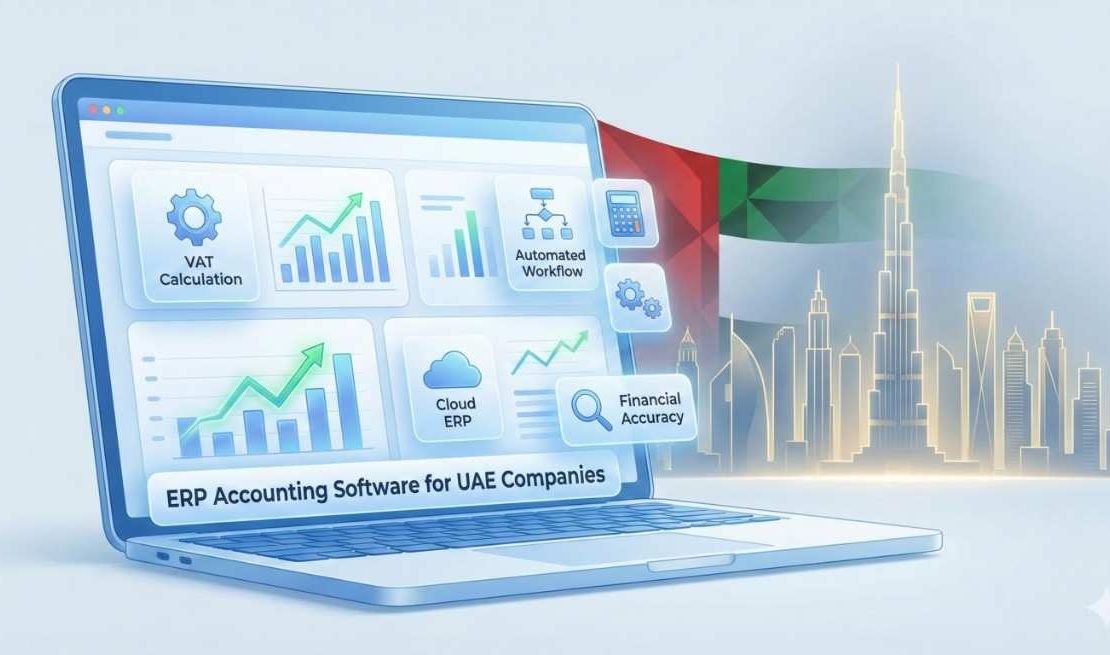
Operating in the dynamic and rapidly changing UAE marketplace would need more than the conventional accounting instruments to handle finances. The growth of business slows down efficiency and risks the possibility of mistakes when using manual spreadsheets and disconnected systems. This is where cloud-based ERP and accounting software would be critical. With finance, operations, inventory, HR, and reporting system being integrated into one centralized system, businesses in the UAE can fully realize their business performance.
Regardless of whether you are operating a small start-up or a developing company, the use of modern accounting software UAE can help with accuracy, compliance, and scale. This guide gives the definition of cloud-based ERP accounting software, the functionality and why the solution is the one that is gaining popularity amongst UAE businesses.
What is Cloud based ERP Accounting Software?
Cloud-based ERP accounting software is an accounting program in the form of an online system that incorporates financial management into other central business operations. One does not need to run different tools to do invoicing, payroll, sales, or inventory management system functions but it all runs on a single cloud platform.
The system allows users to have access to it at all times, on any machine without the need to maintain servers and hardware. It eases the working processes by connecting the accounting to Hr operation, procurement, sales and a bank. Cloud accounting ERP is a scalable ERP software Dubai that provides real-time solutions and automation that enhance the decision-making of businesses.
ERP Accounting Software: Its Major Characteristics:
-
General Ledger Automation:
Exacts journal entries, adjustments, financial statements and period closing.
-
Accounts Payable and Receivable:
Automates billing, recurring bill payments, vendor payments and customer collections with less manual errors.
-
Budgeting and Forecasting:
With real-time financial information, Helps UAE companies create budgets, monitor costs, and estimate profitability.
-
Bank Reconciliation:
Automatically balances your bank account to keep track of your money.
-
Tax Management:
Promotes VAT regulations in the UAE and automates VAT calculation, reporting, and filing.
-
Combined HR and Payroll Software:
Integrates financial reporting with leave management, employees salary processing and benefits tracking.
-
Inventory Management System:
Tracks stock flow, valuation, cost of purchase and warehouse performance- all in connection with your accounts.
-
Live Dashboard and Reports:
Offers complete control of financial charts in cash flow, sales annual expenses and profitability.
The advantages of utilizing Cloud-Based ERP in Accounting are:
-
Financial Control: The financial control is centralized.
By integrating all business modules such as finance, HR, sales, and inventory, organizations will be able to get rid of data silos and have a full financial picture.
-
Reduced Operational Costs:
Cloud ERP saves the cost of using costly servers, IT upkeep, and various software licenses.
-
Better efficiency and accuracy:
Automation minimizes the paper work, error by humans and accelerates activities such as reconciliation and reporting.
-
Better Decision-Making:
Real- time financial information assists leaders to react fast to market variations, cost variations and operational requirement.
-
Enhanced Collaboration:
The departmental teams operate on the same updated data enhancing cross-departmental communication and transparency in workflow.
-
Scalability of UAE Based Businesses:
The startups will be able to start small and upgrade their ERP modules when the business grows, and this is perfect when a company is shifting towards online development.
-
Greater Compliance:
The system facilitates the UAE VAT laws, financial standards and regulatory requirements with external controls.
Use of Cloud-based ERP in Accounting:
-
Concentrate All Financial Data:
Begin by transferring invoices, purchase orders, expense records and banking data to the ERP solution. This guarantees that all financial activities are made to go through a single platform.
-
Automate Daily Accounting Operations:
Predefined guidelines on journal entries, routine invoices and scheduled payments. This saves a lot of work done by hand and also gives consistency throughout the system.
-
Use Integrated Modules:
Make accounting related to other crucial modules like:
- HR and payroll software to automate salaries postings.
- Real-time stock valuation inventory system.
- Sales and customer relationship modules to monitor customer revenues.
- Vendor Payments and purchase controls procurement.
This forms an entire financial ecosystem.
-
The Dashboards Business Health Monitor:
Monitor cash flow, revenue patterns, financial breakdowns, and profitability using financial dashboards. Cloud ERP offers real-time analytics in order to have quicker internal reporting.
-
Banks Sync and Reconciliation Automation:
The majority of ERP and accounting software in the UAE are linked directly with local banks and this assists in ensuring that all transactions are properly documented without the need to key in all the transactions manually.
-
Secure Security and User Permissions:
Role and access controls should be used to make employees only access the information that pertains to their line of duty, enhancing accountability and confidentiality.
The selection of the ERP Accounting Software in UAE:
UAE businesses must take into account the following when choosing the ERP accounting software:
-
VAT Compliance:
Make sure the system is comprehensive in terms of supporting UAE VAT filing, invoicing and reporting.
-
Local Market Experience:
Select a provider who knows the business laws in the UAE, industries and the regulatory standards.
-
Scalability:
The ERP must have modular growth today finance, tomorrow, HR or inventory.
-
Cloud Security:
Encryption, backup systems, access controls, and secure hosting should be checked always.
-
Integration Capabilities:
Identify software compatible with:
-
Simple to implement and use:
Choose a vendor that has effective onboarding, local training, and continuous technical support.
Conclusion
ERP and accounting software on the cloud is transforming the methods of financial management used by companies in the UAE. Through consolidation of accounting, HR, inventory, and operations, businesses are able to have a better view, high level of accuracy and scalability over the long term. You may be operating in the city of Dubai or in any part of the UAE, but by embracing modern accounting ERP software, you are bound to be efficient and you are bound to grow.