Introduction
The high pace of the digital transformation throughout the UAE has challenged companies to reconsider the way they deal with money, information, and regulations. The old accounting technologies used to be spreadsheets, simple ledgers, and dis-integrated software which can no longer keep pace with the current fast-paced market.
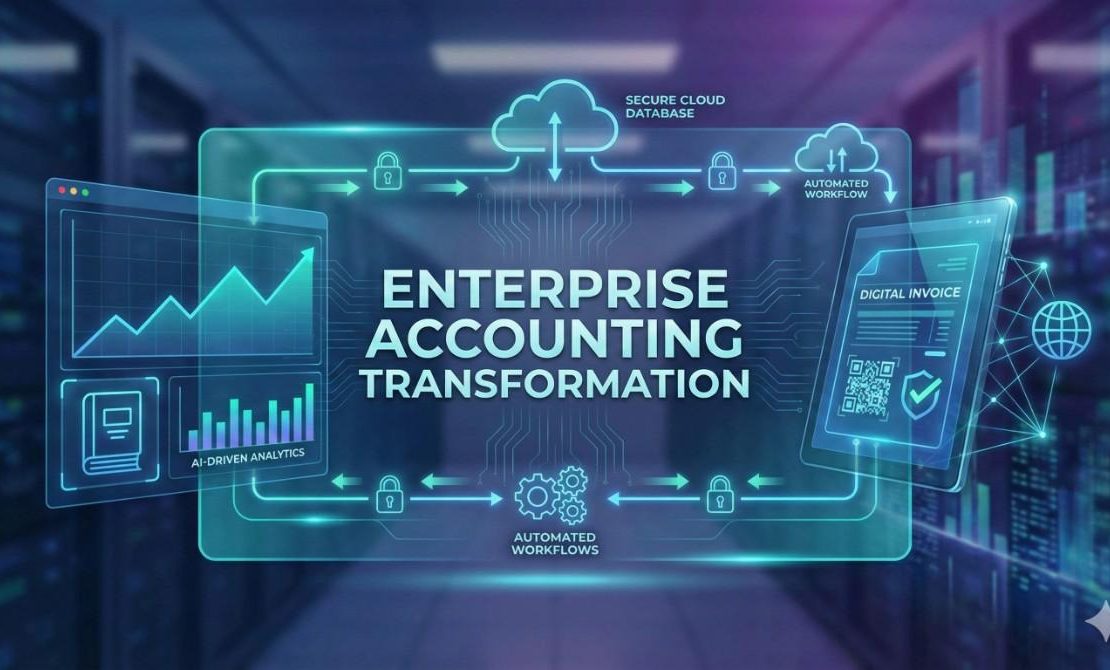
Because of this, several organizations are resorting to enterprise accounting system which is a powerful system that automates, integrates and consolidates all financial processes within a single system.
Enterprise accounting solutions are based on modern technologies and cloud infrastructure that allows the company to optimize the functioning, remove inefficiencies, and promote long-term growth.
The following guide explains the nature of accounting systems used by enterprises, how the systems facilitate the transformation of accounting, and why UAE companies should think of upgrading to the more powerful and scalable financial tools.
Enterprise Accounting Systems What Are?
Enterprise accounting systems are integrated and sophisticated systems that run also financial operations of medium to large organizations. In contrast to simple accounting software UAE employed to do simple bookkeeping, enterprise-level software links finance with the other business modules like sales, procurement, HR, warehouse, and supply chain.
They are the financial support behind a company as they provide:
Due to this integration, the enterprise accounting systems have been known to be a part of a full ERP and accounting software suite. This means that businesses are in a position to handle all the aspects of costs and revenues to payroll and stocks within one system.
Important Enterprise Accounting System Components and Features:
Enterprise accounting software is much more than simple transaction records. It has a number of strong elements that are used to manage complicated financial requirements of the corporations.
Management of General Ledger (GL):
The GL is the financial center of the system which consolidates all the monetary transactions, adjustments and financial statements. It provides support of multi-currency and multi-branch, which is perfect in the context of diversification of business in the UAE.
Accounts Payable: Accounts Receivable:
Automates the payment to the vendor, billing to the customers, credit, and collection processes in order to diminish the delays and human error.
Financial Planning and Budgeting:
Facilitates evidence-based forecasting, budgeting and variance calculations, which assist businesses to make financial plans related to future objectives more precise.
Fixed Asset Management:
Tracks asset life cycles- acquisition and depreciation to disposal and has complete audit trails.
Banking Integration & Reconciliation:
Enterprise systems are integrated with UAE banks, which can automatically reconcile and track transactions and see their financial performance in real-time.
Inventory Management System integration:
Manages inventory, store management, retailing and purchasing. Being combined with accounting, all stock movements are immediately reflected in financial statements.
Tax & Compliance Automation:
VAT accuracy is a significant need by UAE businesses. Enterprise accounting system automates calculations, filing and compliance of VAT to provide error free reporting.
HR and Payroll Connectivity:
Most systems are combined with payroll and financial accounts and make it easy to post salary, employee reimbursement, end of service benefits, and compliance reporting.
Advanced Reporting: Dashboards:
Custom financial dashboards enable CFOs, accountants and managers monitor KPIs, profitability, cash flow and expenses in real time.
Basic Features of the Modern Enterprise Accounting Software:
The modern enterprise level financial systems are robust, versatile and complete cloud infrastructure. They have the fundamental capabilities of:
End-to-End Automation:
Automated accounting processes can reduce manual work in areas such as billing, reconciliations, and reporting and save time and enhance the accuracy.
Instant Intelligence to make better decisions:
Financial data is immediately accessible to the management teams so that they can react to changes in the market.
Full Integration between Departments:
Modern solutions will be compatible with:
- Sales and CRM
- Procurement
- Supply chain
- HR and payroll software
Warehouse and inventory management system.
Such a single ecosystem enhances the overall efficiency and removes duplication of data.
Scalability of Expanding UAE Businesses:
Enterprise systems increase with the growth of companies and the introduction of new branches and new revenue streams. This is what makes them effective in organizations that desire long term growth.
Enhanced Security and Data controls:
Cloud-based solutions are encrypted, backed up, have access control, and audit trails that are crucial in keeping the data safe – this is particularly in businesses operating in areas that focus on compliance rules such as the UAE.
Multi-Currency and Multi-Language Support:
It is useful in the case of businesses based in Dubai, Abu Dhabi, and other cities of the UAE where teams tend to deal with various currencies and multilingual activities.
The Conventional Fallacies and Myths of ERP Accounting to Enterprises:
Most companies postpone their accounting transformation because they have old assumptions. The most popular myths are the following:
Myth 1: ERP systems cost too much.
The current ERP and accounting software can be purchased in a flexible pricing model of SaaS, subscription, or modular, which is affordable even to the small and medium businesses in the UAE.
Myth 2: “The implementation is too complex.
The erp companies in uae have become quicker to on-board, offer and train in intense detail, and industry templates, making the change easier.
Myth 3: Enterprise systems are only implemented in large companies.
Automation, real-time reporting, and integration are also beneficial to even small businesses. Scalability will enable them to be small and upgrade as they grow.
Myth 4: Cloud based systems are insecure.
As a fact, cloud ERP systems provide better security than on-premise systems, where encryption, backups and stringent access control are involved.
Myth 5: ERP substitutes the accounting department.
The ERP systems are helpful to accountants, not to replace them. Automation reduces repetitiveness in work and the teams can concentrate on strategy, analysis and decision making.
New Direction in Enterprise Accounting:
The accounting environment in UAE is fast changing. The following are the latest trends that define enterprise finance:
Artificial Intelligence in Fintech:
Predictive analytics, fraud detection, anomaly detection, and automated reconciliation are some of the tasks that artificial intelligence supports at present.
In the current Accounting Transformation, Clouds-First:
Majority of ERP software dubai supplier are moving to cloud platform to achieve mobility, scalability, and cost effectiveness.
HR, Payroll and Finance Incorporation:
Standardized platforms minimize the number of errors, ease compliance, and provide a 360 perspective of the workforce costs.
Financial Visibility in real-time:
Organisations can expect financial KPIs to be accessible instantly, instead of closing them at the end of the month.
Mobile Accounting:
Mobile apps are becoming popular with CFOs and managers as they receive approval of expenses, reports, and real-time monitoring of transactions.
Conclusion:
Enterprise accounting systems are becoming a requirement and not a luxury to organizations in the UAE. They enhance the accuracy, make compliance easier and provide a more agile financial environment. In accounting transformation, modern ERP and accounting software is the best way forward by companies aiming to achieve efficiency and growth that is scalable.
Businesses can use integrated components such as HR, payroll, procurement and inventory which allows them to handle all business functions on a single platform. Since UAE is still on its path to digitalization, collaboration with the appropriate ERP firms in UAE will guarantee a successful future and financial accountability.